“India Will Pay Tariffs, We Won’t”: Trump After Supreme Court Ruling
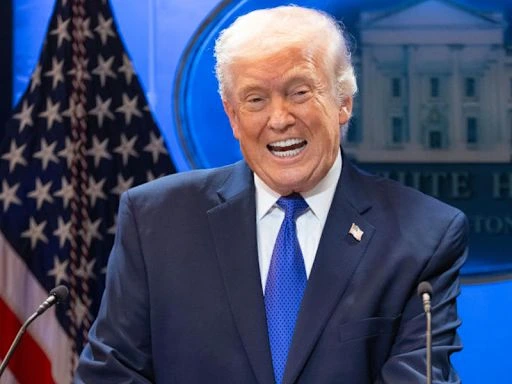
21-feb-2026, 12:52 PM In a sharp reaction following a recent Supreme Court decision, former US President Donald Trump stated, “India will pay tariffs, we won’t,” reigniting discussions around global trade policy and America’s economic strategy toward key partners like India.
The remark comes in the context of ongoing debates in the United States over tariff authority, executive powers, and trade policy following a Supreme Court ruling that addressed aspects of federal regulatory or trade-related authority. Trump’s response signals a potential hardline approach to tariffs should he return to office.
What Did Trump Say?
Speaking to reporters and supporters, Trump emphasized that under his approach to international trade, the United States would not bear the burden of tariffs in trade disputes. Instead, he argued that trading partners such as India would shoulder the economic impact.
His statement reflects a continuation of the “America First” trade doctrine that characterized his administration from 2017 to 2021 — a period marked by tariff battles, renegotiated trade deals, and heightened scrutiny of trade deficits.
Understanding the Context
The comment followed a Supreme Court ruling related to federal authority and trade or regulatory mechanisms. While the ruling itself focused on constitutional or statutory interpretation, Trump used the moment to reiterate his broader trade philosophy.
During his presidency, Trump frequently imposed tariffs on countries he believed were engaging in unfair trade practices. Although much of the global tariff confrontation centered on China, India also faced tariff measures during that period, particularly concerning steel, aluminum, and certain export privileges.
US–India Trade Relations: A Strategic Balance
The United States and India share a complex economic relationship. Bilateral trade between the two countries has grown steadily over the past decade, covering sectors such as:
Technology and digital services
Pharmaceuticals
Energy exports
Defense cooperation
Despite strategic alignment in areas such as Indo-Pacific security, trade disputes have occasionally surfaced over market access, agricultural products, medical devices, and tariff structures.
Trump’s statement may therefore resonate politically within domestic US debates, but it also has diplomatic implications for relations with India.
Tariffs: Who Really Pays?
One of the long-standing debates in global economics concerns who actually bears the cost of tariffs.
While political rhetoric often suggests that foreign governments “pay” tariffs, economists generally argue that tariffs are paid by importers within the country imposing them. These costs can then be passed on to consumers through higher prices or absorbed by businesses through reduced profit margins.
Trump’s framing — that India would “pay tariffs” — reflects a political interpretation aimed at emphasizing leverage in negotiations rather than a strict economic accounting perspective.
Political Significance Ahead of Elections
Trump’s remarks come amid heightened political campaigning and legal developments in the United States. Trade policy remains a major issue for American voters concerned about:
Domestic manufacturing
Supply chain security
Inflation
Job protection
By invoking India specifically, Trump may be signaling that his tariff strategy would extend beyond traditional rivals to any nation he believes maintains unfair trade advantages.
The statement also underscores how global trade continues to be used as a political tool in US domestic discourse.
India’s Likely Response
India has historically responded to tariff measures through diplomatic engagement and, at times, reciprocal tariffs. In previous trade disputes, New Delhi balanced assertiveness with strategic cooperation, especially given the growing defense and geopolitical partnership with Washington.
If tariff rhetoric escalates, India may choose to:
Engage in negotiations through bilateral trade mechanisms
Raise concerns at the World Trade Organization
Adjust retaliatory measures proportionally
However, much would depend on actual policy implementation rather than campaign statements.
Broader Global Impact
Global markets are highly sensitive to tariff announcements and trade tensions. Past tariff wars led to:
Volatility in stock markets
Disruptions in global supply chains
Increased production costs
Strain on diplomatic relations
Given India’s growing role in global manufacturing and technology services, any renewed tariff conflict could have ripple effects across Asia, Europe, and North America.
Conclusion
Donald Trump’s statement — “India will pay tariffs, we won’t” — reflects a continuation of his assertive trade rhetoric following a Supreme Court ruling. While the immediate legal context centers on domestic US governance, the political message is clear: trade policy remains central to Trump’s economic agenda.
Whether this translates into concrete policy shifts will depend on electoral outcomes and diplomatic engagement. For now, the comment serves as a reminder that trade remains both an economic instrument and a powerful political message in global affairs.