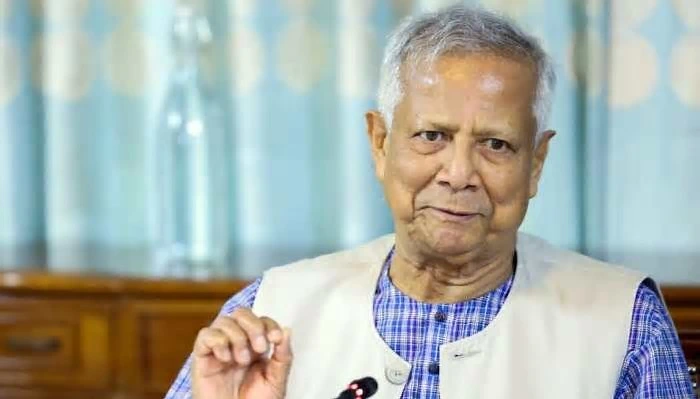
17-feb-2026, 11:50 AM, Outgoing Bangladesh interim Chief Adviser Muhammad Yunus referred to India’s northeastern states, known collectively as the “Seven Sisters”, and highlighted Bangladesh’s growing engagement with China in his farewell address.
Yunus delivered the address as his interim administration was coming to an end and Bangladesh prepared for the formation of a new elected government under BNP leader Tarique Rahman.
In his speech, Yunus emphasised Bangladesh’s sovereignty, national interests and independent foreign policy. He also discussed the country’s geographic position and its potential to serve as a gateway to global markets for neighboring regions.
What Did Yunus Say About the Seven Sisters?
During his farewell address, Yunus referred to the northeastern states of India as the Seven Sisters while discussing Bangladesh’s economic potential.
He said Bangladesh’s access to the sea could provide opportunities for economic cooperation involving Nepal, Bhutan and the Seven Sisters.
Yunus described Bangladesh’s open sea as a gateway to the global economy and said the region had significant potential for economic zones, trade agreements and duty-free market access.
The Seven Sisters refers to Assam, Arunachal Pradesh, Meghalaya, Manipur, Mizoram, Nagaland, and Tripura, which are India’s northeastern states.
Yunus’s decision to mention the Seven Sisters without directly naming India attracted attention because India-Bangladesh relations had already experienced considerable tensions during his interim administration.
Why Did the Remark Attract Attention?
Yunus’s comments were significant because of the existing sensitivity surrounding India’s northeastern region and Bangladesh’s geographic position.
Bangladesh shares borders with several northeastern Indian states and provides important routes for regional connectivity.
India has also invested in connectivity and infrastructure projects aimed at improving links between its northeastern states and the rest of the country.
Against this background, Yunus’s suggestion that Bangladesh’s sea access could provide economic opportunities for the Seven Sisters was viewed by some Indian commentators as a politically sensitive statement.
However, the speech itself presented the reference in the context of regional economic cooperation and connectivity. It is important not to present interpretations about Yunus’s intentions as established facts.
Yunus Highlights China’s Role
China also featured prominently in Yunus’s farewell address.
The outgoing chief adviser highlighted what he described as progress in Bangladesh’s cooperation with Beijing.
Among the projects he mentioned was the Teesta River restoration project, which has attracted attention because of its location and the involvement of China.
Yunus also referred to progress on a planned 1,000-bed international hospital in Nilphamari.
The mention of these projects reflects the broader role China has played in Bangladesh’s infrastructure and development plans.
For India, developments involving Chinese-backed projects near strategically sensitive areas are closely watched.
The Teesta Project
The Teesta River project is particularly significant in the context of India-Bangladesh relations.
The Teesta is a transboundary river flowing through India and Bangladesh, and water-sharing has been a longstanding issue between the two countries.
The proposed restoration and management project involving Chinese participation has therefore attracted attention in New Delhi.
During his farewell address, Yunus pointed to progress on the project as one example of Bangladesh’s expanding international cooperation.
The project is separate from the long-running India-Bangladesh negotiations over Teesta water sharing, and the two issues should not be treated as the same matter.
Yunus Says Bangladesh Is No Longer “Submissive”
Another notable part of Yunus’s farewell speech was his description of Bangladesh’s foreign policy.
He said the country was no longer following a “submissive” foreign policy or relying on instructions and advice from other countries.
Yunus said Bangladesh was now more confident in protecting its independent interests and emphasised the importance of maintaining what he called a strategic balance in its international relationships.
Although Yunus did not explicitly identify India when making the statement, the remarks were widely interpreted in the context of the strained relationship between Dhaka and New Delhi.
For a neutral news report, however, it is better to describe this as an interpretation rather than state that the remarks were definitely directed at India.
Yunus and China’s Growing Relationship
During his time leading Bangladesh’s interim government, Yunus sought to maintain relations with several major powers.
China became an increasingly important partner, particularly in infrastructure and economic cooperation.
Yunus’s farewell address highlighted cooperation not only with China but also with Japan, the United States, and European countries.
His reference to “strategic balance” suggested that Bangladesh intended to maintain relationships with multiple international partners rather than depend heavily on a single country.
Yunus Had Earlier Mentioned the Seven Sisters in China
This was not the first time Yunus had spoken publicly about India’s northeastern states.
During his visit to China in March 2025, he described the Seven Sisters as a landlocked region and presented Bangladesh’s access to the sea as an economic opportunity.
At the time, his remarks attracted criticism in India because he suggested that the region could be connected to wider Chinese economic activity through Bangladesh.
The latest reference in his farewell speech therefore revived an issue that had already contributed to tensions between the two countries.
India-Bangladesh Relations Under Yunus
Relations between India and Bangladesh became more complicated during Yunus’s interim administration.
Issues including border management, trade, political developments and the future of former Prime Minister Sheikh Hasina contributed to tensions.
The repeated focus on India’s northeastern region also became a sensitive issue.
At the same time, Bangladesh continued to maintain economic and diplomatic relations with India, while both countries remained important to each other’s regional interests.
It would therefore be inaccurate to describe the relationship as completely broken.
A New Government Takes Charge
Yunus’s farewell address came at an important political moment for Bangladesh.
The interim government was preparing to hand over power following the country’s general election.
BNP leader Tarique Rahman was set to become prime minister, marking a transition from the interim administration to an elected government.
The new government faces the challenge of managing Bangladesh’s relationships with India, China, and other major international partners.
Its foreign policy decisions could determine whether tensions with New Delhi ease or continue.
What Could Happen to India-Bangladesh Ties?
The transition to a new elected government could create an opportunity for India and Bangladesh to reset their relationship.
Both countries have strong economic, geographical, and cultural connections.
India remains an important neighbor for Bangladesh, while Bangladesh is strategically significant for India’s northeastern region.
Trade, connectivity, border security, river-water issues, and regional transport links are likely to remain important areas of discussion.
The new government will also have to balance its relationship with China while maintaining ties with India and other international partners.
Why the Farewell Speech Matters
Yunus’s final address provides an indication of how his interim administration viewed Bangladesh’s place in regional affairs.
His emphasis on sovereignty, strategic balance, China, and Bangladesh’s access to the sea reflected an effort to present the country as an independent regional economic player.
At the same time, his reference to the Seven Sisters highlighted the geographical importance of Bangladesh to India’s northeast.
Whether these themes continue under the new government will depend on the foreign-policy priorities of the elected administration.
Conclusion
Muhammad Yunus’s farewell address brought renewed attention to Bangladesh’s relationship with India and China.
His reference to India’s Seven Sisters, combined with his comments about Bangladesh’s sea access, economic potential, and growing cooperation with China, drew attention because of the existing sensitivities between Dhaka and New Delhi.
Yunus also described Bangladesh as a country pursuing an independent foreign policy and emphasised the importance of strategic balance.
With the interim government giving way to an elected administration led by Tarique Rahman, the focus will now shift to how the new government manages relations with India, China, and other regional partners.
The future of India-Bangladesh ties will likely depend on practical issues such as trade, connectivity, border management, water-sharing, and regional cooperation.
Sources: India Today, NDTV, and The Week.