
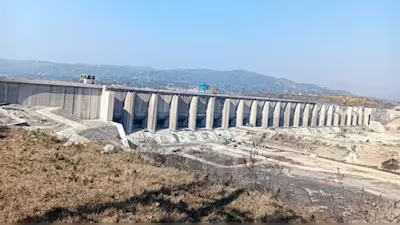
18-feb-2026, 2:45 PM In a significant national development, India is set to stop the flow of surplus water from the Ravi River into Pakistan as the long-pending Shahpur Kandi Dam project approaches completion. The move comes amid renewed discussions surrounding the implementation of the Indus Waters Treaty, which governs water-sharing arrangements between the two neighbouring nations.
The development is being viewed as both a strategic and economic milestone, aimed at ensuring optimal utilisation of India’s share of river waters while strengthening irrigation and power generation capabilities in northern states.
Background: The Indus Waters Treaty Framework
Signed in 1960 between India and Pakistan with the World Bank as a broker, the Indus Waters Treaty allocated the waters of six rivers between the two countries.
The three eastern rivers—Ravi, Beas, and Sutlej—were allocated to India.
The three western rivers—Indus, Jhelum, and Chenab—were allocated to Pakistan, with limited usage rights granted to India.
While India has full rights over the eastern rivers, including the Ravi, historical infrastructure limitations resulted in a portion of surplus Ravi water flowing into Pakistan unused. Over the years, Indian policymakers have emphasized the need to fully harness this allocated share.
What Is the Shahpur Kandi Project?
The Shahpur Kandi Dam, located in Punjab near the border with Jammu and Kashmir, is a critical infrastructure project designed to utilise the waters of the Ravi River more efficiently.
The project aims to:
Irrigate thousands of hectares of farmland in Punjab and Jammu & Kashmir
Generate hydroelectric power
Prevent surplus water from flowing unutilized across the border
Construction delays over the past decades had slowed progress. However, renewed political focus and inter-state coordination have accelerated completion efforts.
Once operational, the project will allow India to store and channel Ravi water effectively within its territory.
Why Is This Move Significant?
1. Optimal Utilization of Water Resources
For years, surplus Ravi water flowed into Pakistan simply because India lacked the infrastructure to store and divert it effectively. With the Shahpur Kandi project nearing completion, India can now utilize its rightful share under the treaty.
This means enhanced irrigation capacity for farmers and improved agricultural productivity in water-stressed areas.
2. Strategic Implications
Water-sharing issues have historically been sensitive between India and Pakistan. Although India has remained compliant with the Indus Waters Treaty, policymakers have occasionally highlighted the need to maximize usage of allocated rivers.
By fully utilizing Ravi waters, India reinforces its sovereign rights under the treaty without technically violating any provisions.
3. Boost to Agriculture and Power
The project is expected to benefit farmers in Punjab and parts of Jammu & Kashmir by ensuring more reliable irrigation supply. Additionally, hydroelectric power generation will contribute to regional energy security.
Political and Diplomatic Context
India-Pakistan relations have experienced tensions in recent years. In this broader geopolitical environment, infrastructure projects tied to river waters naturally attract attention.
However, experts clarify that stopping surplus Ravi water flow is not a treaty violation. Instead, it represents delayed implementation of India’s long-held rights.
Indian officials have repeatedly stated that the country will utilize every drop of water allocated to it under the Indus Waters Treaty.
Impact on Punjab and Jammu & Kashmir
The Shahpur Kandi project is expected to transform irrigation patterns in:
Pathankot region of Punjab
Kathua district in Jammu & Kashmir
Farmers in these regions often depend heavily on monsoon rainfall and groundwater extraction. Improved canal irrigation can reduce groundwater depletion, a major environmental concern in Punjab.
Better irrigation infrastructure may also encourage crop diversification, reducing overdependence on water-intensive crops like paddy.
Environmental Considerations
Water management projects often raise environmental concerns. However, supporters argue that proper river utilization within treaty rights does not equate to river diversion or damming beyond allocated limits.
Sustainable water use practices, environmental clearances, and ecological assessments are part of the implementation process.
In fact, better storage and channeling may reduce wastage and seasonal flooding risks.
Economic Implications
Harnessing surplus Ravi water could generate:
Increased agricultural output
Improved rural income
Enhanced hydroelectric generation
Long-term infrastructure benefits
In water-scarce economies, efficient utilization of river systems plays a crucial role in food security and regional development.
Pakistan’s Likely Response
While India maintains that the move is within treaty provisions, Pakistan may view it with concern given the broader political climate.
Historically, disputes under the Indus Waters Treaty have been resolved through diplomatic channels, technical negotiations, or arbitration mechanisms.
However, since the Ravi River is one of the eastern rivers fully allocated to India, Pakistan’s legal standing in opposing such utilization may be limited.
Broader Indus Treaty Debate
Over the years, voices in India have called for revisiting or reviewing the Indus Waters Treaty, especially after periods of heightened bilateral tensions.
Despite these calls, the treaty has survived wars and political upheavals for over six decades, often cited globally as a successful water-sharing agreement.
India’s current move reflects a focus on implementation rather than withdrawal or renegotiation.
Infrastructure as Strategic Policy
Large-scale infrastructure projects like Shahpur Kandi serve multiple policy objectives:
Economic development
Agricultural reform
Energy generation
Strategic signaling
By completing long-pending projects, the government underscores its commitment to resource optimization and regional development.
The Road Ahead
As the Shahpur Kandi project nears full operational status, the focus will shift to:
Ensuring smooth water diversion mechanisms
Monitoring environmental impact
Coordinating irrigation management
Maintaining diplomatic communication
The success of the project may also accelerate other pending river management initiatives across the country.
Conclusion
India’s decision to stop surplus Ravi water flow into Pakistan as the Shahpur Kandi project nears completion marks a major step in resource management and infrastructure development. Rooted in the framework of the Indus Waters Treaty, the move underscores India’s intention to fully utilize its allocated share of river waters.
Beyond geopolitics, the project promises tangible benefits—improved irrigation, enhanced agricultural productivity, and increased power generation for northern states.
While diplomatic sensitivities remain, the development represents a strategic yet legally grounded assertion of water rights. As the dam becomes operational, its real impact will be measured not only in cubic meters of water stored but also in the economic and social transformation it enables across affected regions.