Political Confrontation Intensifies in Parliament
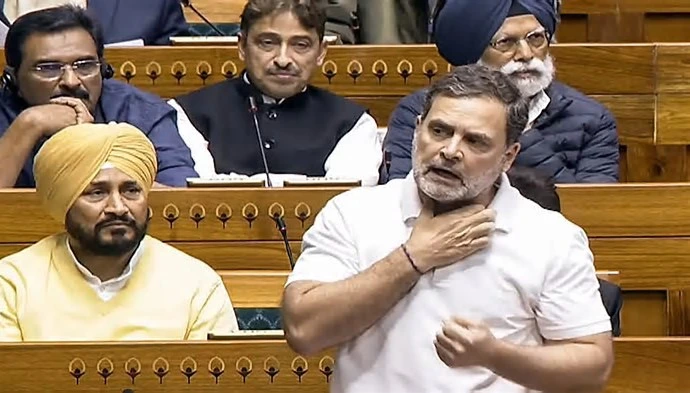
133-feb-2026, 4:45 A fresh political storm has erupted after senior Congress leader Rahul Gandhi openly challenged the Bharatiya Janata Party (BJP) over reports suggesting a possible move to seek his disqualification from Parliament. Responding to the controversy, Rahul Gandhi declared, “File an FIR or bring a privilege motion, I’ll fight.”
His statement signals a direct and combative stance, setting the stage for yet another high-voltage political face-off between the ruling BJP and the principal Opposition party.
What Sparked the Disqualification Debate?
The latest controversy stems from remarks allegedly made by Rahul Gandhi during recent public engagements and parliamentary discussions. BJP leaders have claimed that his statements were misleading and potentially damaging to India’s reputation or parliamentary integrity.
Sources within the BJP indicated that party members were considering formal procedural action. Among the options reportedly discussed were filing a privilege motion in Parliament or initiating legal proceedings through a First Information Report (FIR).
While the BJP has not officially confirmed a final course of action, the very suggestion of disqualification has added fuel to an already tense political atmosphere.
Rahul Gandhi’s Counterattack
Rather than retreating, Rahul Gandhi adopted a confrontational tone. By publicly daring the BJP to proceed with legal or parliamentary measures, he reframed the issue as a matter of democratic principle rather than procedural violation.
His remarks appear calculated to send a strong message — both to his political opponents and to his supporters — that he is willing to defend his statements inside and outside Parliament.
Political analysts note that such defiance serves two purposes:
It projects confidence and readiness to face scrutiny.
It shifts public focus toward questions of free speech and democratic space.
Understanding a Privilege Motion
A privilege motion is a serious parliamentary mechanism. It is invoked when a Member of Parliament is believed to have breached parliamentary privilege or misled the House. If admitted by the Speaker, the matter is typically referred to the Privileges Committee for investigation.
Consequences can range from admonition to suspension, depending on the findings. However, such motions are relatively rare and often carry significant political implications.
The mere discussion of invoking this procedure signals escalating tensions within Parliament.
The BJP’s Position
The BJP has consistently maintained that parliamentary decorum and factual integrity must be preserved. Party leaders argue that no elected representative is above institutional accountability.
From the BJP’s perspective, if statements made inside or outside Parliament cross certain lines, procedural remedies are available under established rules. Supporters of the ruling party say that accountability strengthens democratic institutions rather than weakens them.
However, critics argue that such measures can sometimes be used as political tools to curb dissent.
Congress Calls It ‘Political Targeting’
The Congress party has dismissed the reported move as politically motivated. Party leaders claim that repeated actions against Opposition figures reflect a broader pattern aimed at silencing critics of the government.
They argue that aggressive procedural tactics undermine democratic discourse and discourage robust debate within Parliament.
For Congress, this episode fits into a larger narrative of institutional pressure faced by Opposition leaders in recent years.
A Pattern of Parliamentary Flashpoints
The confrontation is not an isolated incident. Over the past few sessions, Parliament has witnessed multiple flashpoints involving heated exchanges, suspensions, and procedural battles.
Opposition leaders have frequently accused the government of stifling debate, while the ruling party has countered by accusing the Opposition of disruption and misinformation.
The latest episode involving Rahul Gandhi adds another layer to this ongoing clash.
Legal and Political Ramifications
If the BJP proceeds with filing an FIR or moving a privilege motion, several outcomes are possible:
The Speaker may accept or reject the motion.
A committee inquiry could be initiated.
The matter could evolve into a prolonged legal battle.
Politically, however, the impact may extend beyond procedural outcomes.
For Rahul Gandhi, the episode could strengthen his positioning as a vocal critic of the government. For the BJP, pursuing action may reinforce its narrative of institutional accountability.
Public Perception and Electoral Calculations
In contemporary politics, perception often matters as much as procedure. Both parties are likely weighing the public messaging implications of the controversy.
Rahul Gandhi’s strong words may resonate with supporters who see him as standing up to authority. Meanwhile, the BJP may present itself as defending constitutional processes.
With upcoming electoral contests on the horizon, every parliamentary confrontation takes on added strategic importance.
Opposition Unity at Stake
The episode may also influence broader Opposition dynamics. If other parties perceive the move as excessive, it could encourage greater unity among anti-BJP forces.
Conversely, if the matter is seen as procedural and justified, some regional parties may distance themselves from the dispute.
In India’s coalition-driven political landscape, such developments often ripple beyond the immediate conflict.
The Bigger Democratic Question
Beyond partisan rivalry, the controversy raises deeper questions:
Where does the line lie between political criticism and parliamentary breach?
How should institutional mechanisms be used in politically charged environments?
What balance should be maintained between accountability and freedom of expression?
These questions extend beyond individual leaders and speak to the evolving nature of parliamentary democracy.
Conclusion: A Battle of Narratives
The clash between Rahul Gandhi and the BJP over a potential disqualification move reflects more than just procedural disagreement. It highlights the sharpening political divide and the intensifying contest for narrative control in Indian politics.
Whether the BJP formally proceeds with a privilege motion or FIR remains to be seen. What is certain, however, is that the political temperature in New Delhi continues to rise.
As both sides hold firm, the episode becomes another defining moment in an ongoing battle — one fought not just in Parliament, but in public opinion, legal forums, and electoral arenas.