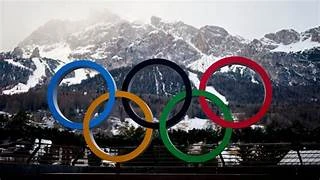
16-FEB-2026, 2:35 PM, The 2026 Winter Olympics have once again highlighted the difficult relationship between international sport, political expression and free speech. A controversy surrounding a political symbol has sparked debate over how far athletes and participants should be allowed to express their views during major sporting events.
The discussion has raised an important question: Should political expression be restricted at sporting competitions, or should athletes have the freedom to communicate their views even while representing their countries?
The issue has attracted attention because the Olympics are designed to bring athletes from different countries together in the spirit of competition. At the same time, athletes are individuals with their own opinions, beliefs, and experiences.
Why Political Symbols Are Controversial at Sporting Events
International sporting organisations generally try to keep competitions focused on sport rather than political disputes.
The reason is relatively straightforward. Major sporting events bring together participants from countries with different political systems, histories, and international relationships. Allowing political messages without restrictions could potentially turn sporting venues into platforms for political confrontation.
However, deciding what qualifies as a political message is not always easy.
A flag, slogan, badge, or other symbol may have different meanings to different people. Something viewed as a personal expression by an athlete could be interpreted by an organizer as a political statement.
This has created repeated debates across international sport.
The broader history of sport shows that political symbols have appeared at major competitions many times. Sporting events have often become places where national identity, social issues, and political disagreements become visible.
The Free Speech Question
The central issue in the latest debate is freedom of expression.
Supporters of athletes’ rights argue that competitors should not automatically lose their ability to express themselves simply because they are participating in an international sporting event.
Athletes can become influential public figures because millions of people watch them compete. Their visibility gives them an opportunity to raise awareness about issues that matter to them.
From this perspective, restricting every political expression could be seen as limiting an individual’s ability to communicate an opinion.
Critics, however, argue that sporting events require clear rules.
Athletes agree to participate under regulations established by organisers and governing bodies. Those rules can include restrictions on political demonstrations, commercial messages, and other forms of expression.
The challenge is finding a balance between maintaining a neutral sporting environment and respecting individual freedom.
Why Olympic Organisers Try to Maintain Neutrality
The Olympic movement has traditionally promoted the idea that sport should bring people together despite political differences.
This principle is particularly important during the Olympics because athletes from countries with complicated or even hostile relationships compete alongside each other.
Organisers therefore have an interest in preventing competitions from becoming dominated by political disputes.
At the same time, the idea of neutrality can itself become controversial.
When an organisation decides that one symbol is political and another is not, it is effectively deciding how certain forms of expression should be treated.
That is why disputes over symbols can quickly develop into larger debates about fairness and freedom of expression.
Sport and Politics Have Always Been Connected
Although organisers often describe sport as separate from politics, history shows that the two have frequently overlapped.
The Olympics have been used as a stage for national identity, diplomacy and international messaging.
Athletes have also used major sporting events to highlight social and political issues.
One well-known example came during the 1968 Mexico City Olympics, when American sprinters Tommie Smith and John Carlos raised gloved fists during the medal ceremony in a protest associated with the Black Power movement.
More recently, sporting organisations have faced controversies involving political symbols, human rights issues, and social causes.
These examples demonstrate why completely separating sport from politics can be difficult.
Even decisions about which symbols are permitted can become political questions.
Why the Debate Matters for Athletes
For athletes, the issue is more complicated than simply choosing whether to display a symbol.
An athlete participating in the Olympics represents both themselves and, in many cases, their national team.
This creates a conflict between personal identity and the responsibilities associated with representing a country or sporting organisation.
Some athletes believe that international competition should remain focused entirely on performance.
Others argue that their personal experiences and beliefs are an important part of who they are and should not disappear simply because they enter a sporting arena.
The debate therefore involves more than one political symbol. It concerns the broader question of how much personal expression athletes should be allowed during international competitions.
The Role of Sporting Rules
Clear rules are important for international competitions.
Without consistent regulations, organisers could find it difficult to determine which forms of expression are acceptable.
However, rules also need to be applied consistently.
If similar symbols or messages are treated differently depending on the athlete, country or political issue involved, questions about fairness are likely to emerge.
This is why transparency is important when sporting authorities make decisions about political expression.
Athletes and spectators need to understand what the rules prohibit, why those restrictions exist and how decisions are reached.
Could Social Media Make the Debate Bigger?
Social media has made these controversies much more visible.
A political symbol displayed for only a few seconds at a sporting event can quickly be photographed, shared and discussed by millions of people.
As a result, an incident that might once have remained limited to spectators at a venue can become an international debate within hours.
Social media also allows athletes to explain their own positions directly rather than relying entirely on traditional media coverage.
However, online discussions can also become highly polarized.
Different groups may interpret the same symbol in completely different ways, making it difficult to establish a common understanding of the incident.
Finding a Balance Between Expression and Neutrality
The controversy at the 2026 Winter Olympics highlights the difficulty of balancing two legitimate interests.
On one side is the desire to protect athletes’ ability to express themselves.
On the other is the need for sporting organisations to maintain rules that allow international competitions to remain focused on sport.
Neither side of the debate has an easy answer.
A complete ban on political expression could raise concerns about individual rights. At the same time, allowing unlimited political demonstrations could create disputes that distract from competition.
A practical approach may involve clearly defined rules that distinguish between peaceful personal expression and actions that deliberately disrupt an event.
Consistency in applying those rules would also be essential.
What This Means for Future Sporting Events
The debate is unlikely to end with the 2026 Winter Olympics.
International sporting competitions will continue to face questions about political symbols, social movements, and athlete expression.
As athletes become increasingly active on social media, these issues could become even more prominent.
Sporting organizations may therefore need to regularly review their policies and explain them clearly to athletes and spectators.
The goal should be to protect the integrity of competition while recognizing that athletes are also members of society with their own views and experiences.
Conclusion
The political-symbol controversy surrounding the 2026 Winter Olympics has opened a wider discussion about free speech, athlete expression, and sporting neutrality.
The Olympics are intended to unite competitors from around the world, but international sport does not exist completely outside society or politics.
Athletes bring their identities, experiences, and beliefs with them when they compete.
The challenge for sporting authorities is to create rules that protect the sporting environment without unnecessarily restricting legitimate personal expression.
As international competitions continue to attract enormous global audiences, questions about where sport ends and political expression begins are likely to remain part of the conversation.
Sources: International sporting regulations and established reporting on political expression in international sport.