
Your daily dose of news, covering the latest updates in politics, business, sports, entertainment, and more from India and around the world.
Your daily dose of news, covering the latest updates in politics, business, sports, entertainment, and more from India and around the world.
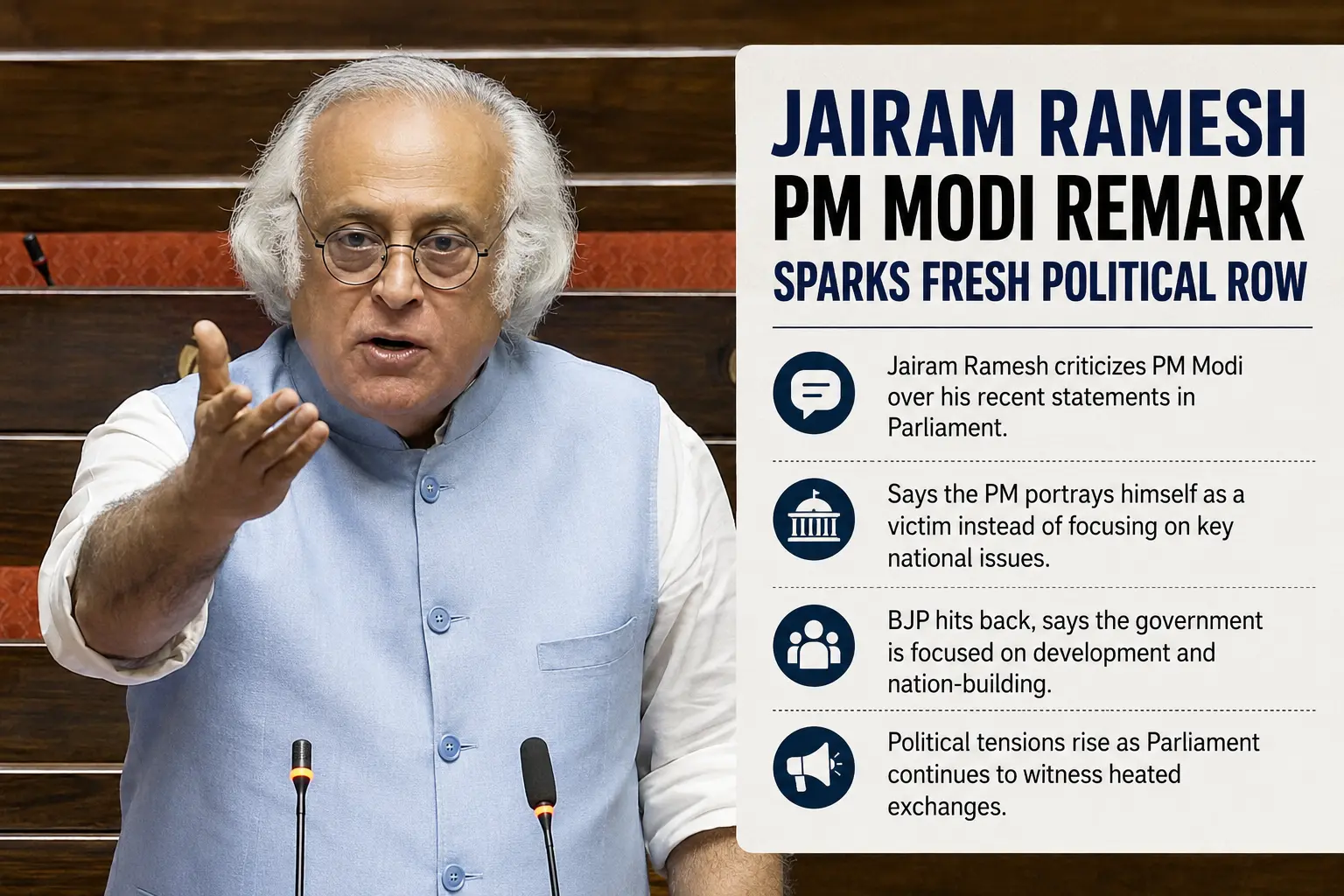
Congress leader Jairam Ramesh launched a sharp attack on Prime Minister Narendra Modi during a recent parliamentary discussion, accusing him of portraying himself as a victim despite holding the country’s highest elected office. The remarks added another chapter to the ongoing political confrontation between the ruling Bharatiya Janata Party (BJP) and the opposition Congress.
Speaking in Parliament, Jairam Ramesh criticized the Prime Minister’s recent comments and alleged that the government’s political narrative focuses on blaming opponents rather than addressing key national issues. His statement quickly attracted reactions from both sides of the political spectrum and reignited debates over the tone of parliamentary discussions.
Addressing the House, Jairam Ramesh claimed that the Prime Minister frequently presents himself as the target of criticism despite leading the central government. He argued that political discourse should focus on governance, accountability, and policy rather than personal narratives.
The Congress leader also alleged that the Prime Minister often criticizes previous governments and political opponents instead of responding directly to current concerns raised by the opposition.
His remarks were made during a broader parliamentary debate that witnessed repeated exchanges between treasury benches and opposition members.
The latest exchange reflects the continuing political tensions during the ongoing Parliament session.
Both the BJP-led government and opposition parties have engaged in heated debates on multiple issues, including governance, economic policies, national security, and parliamentary procedures.
Recent sessions have witnessed frequent disruptions, sharp verbal exchanges, and competing accusations between political parties over various national matters.
Political analysts believe such confrontations are becoming increasingly common as parties prepare for future electoral contests while attempting to shape public opinion.
Leaders from the ruling BJP defended the Prime Minister and rejected the opposition’s allegations.
Government representatives argued that the administration remains focused on development, economic growth, infrastructure expansion, welfare initiatives, and national security. They maintained that criticism from opposition leaders is politically motivated and intended to divert attention from the government’s achievements.
The BJP also reiterated its commitment to continuing parliamentary discussions on important legislative matters.
Congress leaders have consistently argued that Parliament should serve as a platform for detailed discussions on issues affecting citizens.
The party has repeatedly demanded greater accountability from the government on matters including inflation, unemployment, economic challenges, social welfare, and foreign policy.
Jairam Ramesh stated that constructive debate and transparent responses are essential for maintaining public confidence in democratic institutions.
Opposition parties have also emphasized the importance of allowing uninterrupted discussions on issues they consider significant for the country.
India’s Parliament continues to be the primary forum where political parties present their positions on national issues.
Debates often involve strong criticism, counterarguments, and differing perspectives that reflect the country’s democratic process. While disagreements can be intense, parliamentary discussions provide elected representatives with the opportunity to raise public concerns and question government policies.
Observers note that healthy debate remains an important feature of democratic governance, even when political differences become highly visible.
The remarks made by Jairam Ramesh quickly attracted attention across political circles and social media platforms.
Supporters of the Congress viewed the comments as a direct challenge to the government’s political messaging, while BJP supporters defended the Prime Minister and criticized the opposition’s statements.
Political commentators observed that such exchanges often generate widespread public discussion, especially during Parliament sessions where national issues receive significant media coverage.
The debate also reflects the increasingly competitive political environment in which parties seek to strengthen their positions before upcoming elections.
Despite repeated confrontations, Parliament continues to deliberate on several important bills and policy matters.
Government and opposition leaders are expected to continue engaging in discussions on economic reforms, infrastructure projects, social welfare measures, education, healthcare, and national security during the remainder of the session.
Political observers believe the coming days could witness further debates as both sides continue presenting their views on key legislative priorities.
The functioning of Parliament remains central to India’s democratic system, providing an institutional platform for debate, legislation, and government accountability.
The latest remarks by Jairam Ramesh have once again highlighted the sharp political rivalry between the ruling Bharatiya Janata Party (BJP) and the opposition Congress. Both parties continue to present contrasting narratives on governance, leadership, and national priorities during the ongoing Parliament session.
Political analysts believe such exchanges are likely to continue as major legislative discussions and policy debates move forward. Opposition parties are expected to keep pressing the government on issues they consider important, while the ruling alliance is likely to defend its policies by highlighting achievements in infrastructure, economic growth, welfare programmes, and national development.
The intensity of parliamentary debates often increases during important sessions, particularly when politically significant topics are under discussion. These exchanges receive widespread media attention and frequently become part of the broader national political conversation.
Parliament serves as India’s highest legislative institution, where elected representatives debate laws, examine government policies, and raise issues affecting citizens across the country. Strong disagreements between political parties are a regular feature of democratic functioning, allowing multiple viewpoints to be presented before the House.
While debates can sometimes become heated, they also provide an opportunity for accountability, transparency, and policy discussions that shape future governance. Parliamentary proceedings allow both the government and opposition to explain their positions before the public.
Observers note that constructive dialogue remains essential for strengthening democratic institutions and ensuring that important national issues receive detailed attention. As the current Parliament session progresses, lawmakers will discuss economic reforms, social welfare, governance, and national security in the coming days. Political leaders from both the ruling alliance and the opposition will likely continue presenting their perspectives while seeking public support for their respective positions.
The coming days may witness additional debates and statements as Parliament continues addressing legislative business, with political developments expected to remain closely followed by citizens, policymakers, and the media.
The latest Jairam Ramesh PM Modi remarks have once again highlighted the sharp political divide between the ruling BJP and the opposition Congress. While the Congress accuses the government of avoiding important questions, the BJP maintains that its focus remains on development and governance. As Parliament continues its proceedings, leaders from both sides will defend their positions on major national issues, leading to intense political exchanges.
Source: ANI

Your trusted source for news, updates, and insights from India and around the world.
Copyright © 2020–2026 NEWSHOTS. All Rights Reserved.