
Your daily dose of news, covering the latest updates in politics, business, sports, entertainment, and more from India and around the world.
Your daily dose of news, covering the latest updates in politics, business, sports, entertainment, and more from India and around the world.
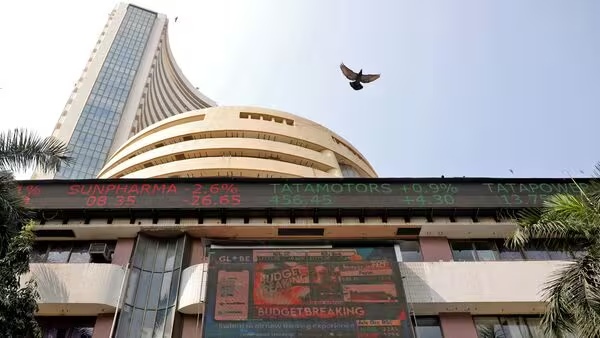
Indian stock markets witnessed a volatile trading session as rising geopolitical tensions between the United States and Iran weighed heavily on investor sentiment. Benchmark indices traded cautiously throughout the day, reflecting concerns over global uncertainty, rising crude oil prices, and potential economic disruptions.
Market participants are closely monitoring global events, as geopolitical risks often influence capital flows, commodity prices, inflation expectations, and overall market confidence. The latest volatility on Dalal Street highlights how interconnected global markets have become and how international events can quickly impact domestic investor sentiment.
According to market data, the BSE Sensex slipped nearly 100 points in early trade, while the NSE Nifty hovered near the 24,300 level. Although markets attempted to recover during the session, investors remained cautious amid developments in the Middle East.
Indian equities opened on a cautious note despite positive indications from GIFT Nifty. Early optimism faded as investors reacted to fresh concerns surrounding the ongoing US-Iran situation.
Key market movements included:
Analysts believe investors are adopting a wait-and-watch approach until there is greater clarity regarding geopolitical developments and their potential impact on the global economy.
The cautious start indicates that investors are currently prioritizing risk management over aggressive buying. Market participants are keeping a close eye on international events before making new investment choices.
The current volatility is largely linked to concerns surrounding the escalating tensions between the United States and Iran.
Financial markets worldwide often react strongly to geopolitical conflicts because they can disrupt trade routes, affect energy supplies, and increase uncertainty for businesses and investors.
Key concerns include:
Investors generally move toward safer assets during periods of geopolitical uncertainty, which can result in increased volatility in equity markets.
Any prolonged conflict in the region could influence commodity prices, investor confidence, and economic activity across multiple countries, making the situation particularly important for global financial markets.
One of the biggest concerns for investors is the sharp movement in crude oil prices.
Reports suggest that fears of supply disruptions in the Middle East have pushed oil prices higher. Markets are particularly focused on developments around the Strait of Hormuz, one of the world’s most important oil transportation routes.
For India, higher crude prices present several challenges:
Since India imports a significant portion of its energy requirements, sustained increases in crude oil prices can affect both economic growth and market sentiment.
Experts believe that crude oil will remain one of the most closely watched indicators in the coming weeks as investors assess the potential impact of geopolitical developments.
Investor sentiment has turned more cautious, contributing to the volatility seen in the stock market.
During uncertain periods, investors often reduce exposure to riskier assets and focus on fundamentally strong companies. As a result, market participation tends to become selective rather than broad-based.
Many traders are currently focusing on:
Short-term traders, meanwhile, are closely tracking global headlines that could influence market direction.
Long-term investors, however, continue to focus on India’s broader growth story and strong economic fundamentals despite temporary market fluctuations.
Despite weakness in benchmark indices, market performance remained mixed across sectors.
Banking and financial stocks displayed relative resilience during the session.
Several large private and public sector banks managed to provide support to the broader indices despite overall market weakness.
Financial stocks benefited from continued investor confidence and relatively stable earnings expectations.
Technology and export-oriented companies faced selling pressure as investors reacted to global uncertainties.
Mid-cap and small-cap stocks also underperformed, indicating a decline in risk appetite among market participants.
Sector-wise differences suggest that investors are becoming more selective in their investments rather than abandoning the market.
Foreign Institutional Investors (FIIs) continue to play an important role in shaping market trends.
Recent sessions have witnessed steady participation from foreign investors, particularly in banking and large-cap stocks.
Their investments have helped:
Experts suggest that sustained foreign inflows may provide support to the markets even if fluctuations continue.
Robust participation from foreign investors is generally seen as an indication of faith in India’s future economic potential.
Recent trading sessions highlight how quickly markets are reacting to geopolitical headlines.
Positive developments often trigger buying activity, while concerns regarding escalation result in immediate selling pressure.
This has created:
Analysts note that volatility is likely to remain elevated until there is greater clarity regarding global developments.
Investors should therefore be prepared for sudden market movements and avoid making investment decisions based solely on short-term fluctuations.
Given his background in engineering, Ternus is likely to prioritize advancements in hardware and emerging technologies.
The move could lead to quicker advancements in Apple’s range of products, from iPhones and Macs to wearable and smart home technologies.
Key Risks Investors Should Watch
Several factors could influence market direction over the coming weeks.
Geopolitical Escalation
Any further deterioration in relations between the US and Iran could increase uncertainty and impact investor confidence.
Rising Oil Prices
Extended periods of elevated oil prices could put strain on consumers and businesses while contributing to higher inflation.
Global Market Weakness
Indian markets often take cues from major international markets, including the United States and Europe.
Currency Movements
Higher crude oil costs may weaken the rupee, leading to higher import bills and reduced profitability for businesses.
Market volatility often creates uncertainty for retail investors, but experts advise against making emotional decisions based on short-term market movements. Instead of reacting to daily fluctuations, investors should focus on their long-term financial goals and investment strategy.
Advisors suggest that investors stay diversified, refrain from panic-driven decisions, and use market pullbacks to accumulate quality stocks. Disciplined investing remains one of the most effective ways to navigate periods of uncertainty and volatility.
Investors should also regularly review their asset allocation and ensure that their investment decisions align with their risk tolerance and financial objectives.
Analysts maintain that Indian stocks continue to show strong underlying fundamentals, even amid short-term volatility.
According to market experts:
Many experts recommend avoiding aggressive trading positions until market conditions become more stable.
They also suggest monitoring earnings reports and economic indicators closely, as these factors may provide additional clues regarding future market direction.
Investors will closely monitor developments related to US-Iran relations, global crude oil prices, and corporate earnings announcements.
Any signs of diplomatic progress could improve sentiment and support a market recovery. On the other hand, further geopolitical escalation may increase volatility and trigger additional caution among investors.
Upcoming earnings reports from major companies, foreign investment trends, and global economic indicators will also play a key role in shaping market sentiment over the coming weeks.
While short-term market movements remain uncertain, India’s economic fundamentals, corporate earnings growth, and continued investor participation continue to provide support for the broader market. As a result, analysts believe long-term investors should remain focused on quality businesses rather than reacting to temporary market fluctuations.
The current market environment may remain challenging, but experienced investors understand that periods of volatility are a normal part of investing. Staying disciplined, focusing on quality assets, and maintaining a long-term perspective may prove beneficial as markets navigate this phase of uncertainty.
Source: ABP Live

Your trusted source for news, updates, and insights from India and around the world.
Copyright © 2020–2026 NEWSHOTS. All Rights Reserved.