
Your daily dose of news, covering the latest updates in politics, business, sports, entertainment, and more from India and around the world.
Your daily dose of news, covering the latest updates in politics, business, sports, entertainment, and more from India and around the world.
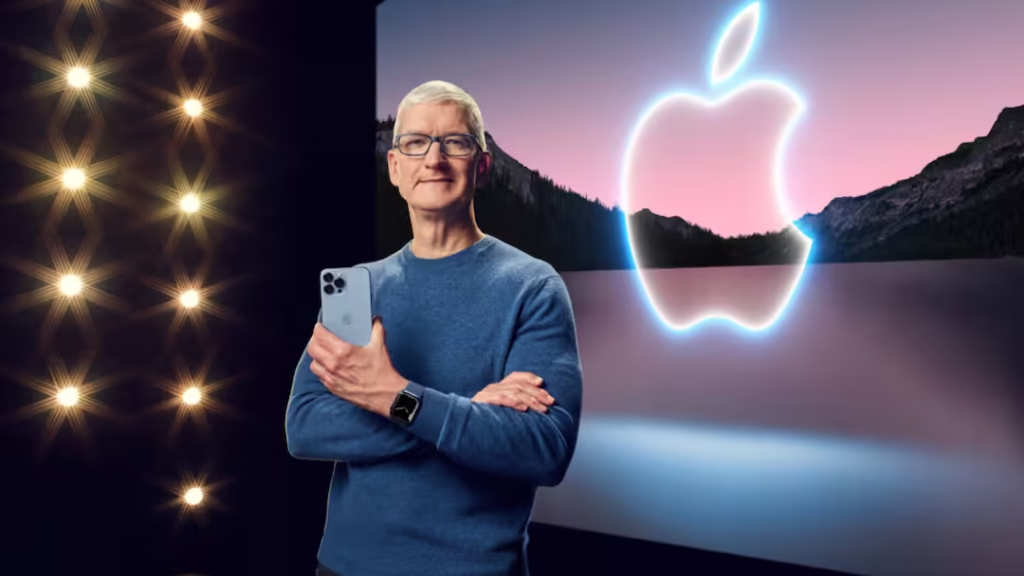
Apple has announced a major leadership transition that will mark the end of an era for the company. According to Apple’s official newsroom announcement, CEO Tim Cook will step down from the role on September 1, 2026, with John Ternus set to succeed him as Chief Executive Officer.
After nearly 15 years as CEO, Cook will become Executive Chairman, while Ternus, Apple’s Senior Vice President of Hardware Engineering, will take over as CEO.
The transition has attracted attention from investors, industry experts and Apple users worldwide. However, the company has presented the change as a carefully planned succession designed to maintain stability and continuity.
Apple’s next CEO will face several challenges. The smartphone market has matured, competition in artificial intelligence is increasing, and consumers continue to expect meaningful innovation.
The transition will also be important for Apple’s ability to maintain its position in a highly competitive technology market. The company will need to continue developing products that attract consumers while responding to changes in areas such as artificial intelligence and advanced hardware. How Ternus balances Apple’s existing strategy with new opportunities will be one of the key areas to watch after he takes over as CEO.
Investors will also look for Apple’s next major product or technology that can support future growth.
Ternus will need to balance Apple’s established strengths with changing technology trends and consumer expectations.
Apple confirmed that Tim Cook will relinquish the CEO role effective September 1, 2026. On the same date, John Ternus will assume the position of Chief Executive Officer.
Cook will not be leaving Apple completely. As Executive Chairman, he is expected to remain involved in strategic initiatives, global policy matters and long-term corporate planning.
The move allows Cook to continue contributing to Apple’s future while transferring day-to-day leadership responsibilities to Ternus.
Planned Succession Strategy
The leadership transition appears to be part of Apple’s long-term succession planning. Rather than being presented as a response to operational difficulties, the move provides an orderly transfer of responsibilities to an experienced internal executive.
A Natural Leadership Milestone
Cook has spent nearly 15 years leading Apple. A transition after such a long tenure can provide the company with a fresh leadership perspective while preserving organizational stability.
Preparing for a New Era
The technology industry is changing rapidly, particularly because of artificial intelligence, advanced computing and next-generation hardware. Ternus’s engineering background could be valuable as Apple navigates these developments.
Tim Cook’s Legacy at Apple
Tim Cook leaves behind a significant leadership record.
When he became CEO in 2011 following Steve Jobs’ passing, there were questions about whether Apple could continue its success under new leadership. During Cook’s tenure, Apple expanded beyond traditional hardware and strengthened its services and wearable-device businesses.
Key developments during Cook’s leadership include:
Cook also developed a leadership style focused heavily on operational excellence, supply chain management and long-term business growth.
John Ternus is less familiar to the general public than Cook but has extensive experience inside Apple.
Ternus joined Apple in 2001 and has spent more than two decades working on important products. As Senior Vice President of Hardware Engineering, he has contributed to products including the iPhone, iPad, Mac, Apple Watch and AirPods.
His long experience gives him a strong understanding of Apple’s engineering teams, products and internal operations.
Apple is unlikely to make dramatic changes immediately, but Ternus’s background could influence several areas.
With extensive engineering experience, Ternus could place greater emphasis on hardware development and next-generation products. This may influence future iPhones, Macs, wearable devices and smart home technologies.
Artificial intelligence has become a major area of competition between technology companies. Apple has faced criticism for moving more cautiously in AI than some competitors.
Under Ternus, Apple may accelerate AI development and integrate more advanced intelligence features into Siri, iPhone, Mac and other products. The exact direction of this strategy remains to be seen.
Despite the leadership change, Apple is expected to maintain its core values and corporate culture. Ternus’s long tenure means he already understands the company’s organization and working environment.
Apple’s next CEO will face several challenges. The smartphone market has matured, competition in artificial intelligence is increasing, and consumers continue to expect meaningful innovation.
Investors will also look for Apple’s next major product or technology that can support future growth.
Ternus will need to balance Apple’s established strengths with changing technology trends and consumer expectations.
For investors, the appointment of an experienced internal executive can reduce uncertainty around the leadership transition.
However, investors will closely watch Ternus’s approach to innovation, AI development and future product launches. His ability to maintain Apple’s strengths while introducing fresh ideas could influence the company’s long-term growth.
John Ternus is expected to assume the CEO role on September 1, 2026, while Tim Cook transitions to Executive Chairman.
Investors, industry analysts and Apple customers will watch Apple’s upcoming product launches, AI initiatives and long-term growth strategy as the transition approaches.
The change represents an important moment in Apple’s recent history, with Cook remaining involved while Ternus takes responsibility for leading the company.
Tim Cook’s move from CEO to Executive Chairman marks the beginning of a new leadership chapter for Apple. After nearly 15 years as CEO, Cook will hand over day-to-day leadership responsibilities to John Ternus on September 1, 2026.
Ternus brings more than two decades of experience at Apple, particularly in hardware engineering and product development. His appointment gives the company an experienced internal executive who already understands its products and operations.
As Apple faces growing competition in artificial intelligence and continuing demands for product innovation, Ternus’s leadership will be closely watched. With Cook remaining as Executive Chairman, Apple is combining continuity with a new leadership direction.
Source: Apple

Your trusted source for news, updates, and insights from India and around the world.
Copyright © 2020–2026 NEWSHOTS. All Rights Reserved.