
Market Decline Amid Global Uncertainty
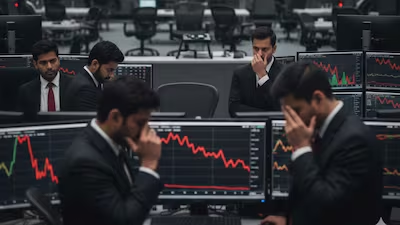
6-MAR-2026, 11:37 India’s stock markets witnessed a noticeable decline as escalating global war tensions rattled investor sentiment across financial markets. Benchmark indices, including the BSE Sensex and Nifty 50, ended the trading session in the red, reflecting growing concerns about geopolitical instability and its potential economic consequences.
The Sensex dropped by 365 points, while the Nifty fell 102 points, marking a cautious day for traders and investors. Analysts believe that the decline was largely influenced by global political developments and fears of wider conflict that could disrupt international trade, supply chains, and energy markets.
Global War Tensions Impact Investor Sentiment
Global markets have been extremely sensitive to geopolitical developments in recent months. News related to escalating tensions between major nations often triggers volatility in stock markets worldwide.
When such events occur, investors tend to move their money into safer assets such as gold, government bonds, or stable currencies. This shift leads to selling pressure in equities, which directly impacts stock market indices.
Experts note that geopolitical tensions can create uncertainty around oil prices, global trade routes, and currency stability. These factors collectively influence investor decisions and lead to fluctuations in markets like the Indian stock exchange.
Sectoral Performance During the Market Fall
Several sectors witnessed selling pressure during the trading session. Banking, technology, and infrastructure stocks were among the biggest contributors to the decline in benchmark indices.
Major financial institutions listed on the Bombay Stock Exchange and National Stock Exchange experienced moderate losses as investors adopted a cautious approach.
Technology stocks were particularly affected because global instability often impacts outsourcing demand and international business confidence. Similarly, banking stocks tend to react sharply to macroeconomic uncertainty since financial institutions are closely tied to economic growth and investment cycles.
However, some defensive sectors such as pharmaceuticals and consumer goods showed relative stability. These industries are often considered safer investments during times of economic uncertainty because demand for essential products usually remains consistent.
Role of Foreign Investors
Foreign Institutional Investors (FIIs) play a significant role in determining the direction of Indian stock markets. During periods of global uncertainty, foreign investors frequently reduce their exposure to emerging markets and shift capital to safer investment destinations.
Market data indicated that foreign investors were net sellers during the session, which contributed to the downward pressure on Indian indices. When large global funds withdraw money from markets like India, it can lead to sudden drops in share prices.
Domestic Institutional Investors (DIIs), including mutual funds and insurance companies, attempted to stabilize the market by increasing their purchases. However, the selling pressure from global investors outweighed the buying support.
Impact of War Tensions on Global Economy
Geopolitical conflicts have far-reaching economic consequences. Apart from immediate market reactions, prolonged tensions can affect trade routes, energy supplies, and international economic cooperation.
For instance, conflicts involving major oil-producing regions can lead to rising crude oil prices. India, being one of the world’s largest oil importers, is particularly sensitive to such developments.
Higher oil prices can increase inflation, weaken the rupee, and raise the cost of transportation and manufacturing. These factors can slow down economic growth and reduce corporate profits, which eventually impacts stock markets.
Therefore, investors closely monitor international developments to anticipate potential economic disruptions.
Expert Views on Market Volatility
Market analysts believe that short-term volatility is inevitable during periods of global uncertainty. However, they also emphasize that India’s long-term economic fundamentals remain strong.
According to market strategists, temporary declines should not necessarily be viewed as indicators of long-term market weakness. Instead, such corrections often create opportunities for investors to buy quality stocks at lower prices.
Experts advise investors to remain cautious but avoid panic selling. Diversification and long-term investment strategies are often recommended during volatile periods.
Historical Trends of Market Reactions
Indian stock markets have historically reacted sharply to global geopolitical events. Similar declines were observed during previous international conflicts, global financial crises, and major political developments.
However, markets have also demonstrated resilience by recovering once the uncertainty subsides. Strong domestic demand, economic reforms, and investor confidence have often helped markets bounce back after short-term setbacks.
The Indian economy’s growing role in global trade and investment has also strengthened its ability to withstand external shocks.
Investor Strategies During Uncertain Times
Financial experts suggest several strategies for investors navigating volatile markets:
1. Long-Term Perspective
Investors should focus on long-term goals rather than reacting to short-term fluctuations.
2. Portfolio Diversification
Spreading investments across different sectors and asset classes helps reduce risk.
3. Defensive Stocks
Sectors such as healthcare, FMCG, and utilities often perform better during economic uncertainty.
4. Monitoring Global Developments
Staying informed about geopolitical events helps investors make more strategic decisions.
Outlook for the Indian Stock Market
Despite the day’s decline, analysts remain cautiously optimistic about the future of Indian markets. India’s strong economic growth outlook, digital transformation, and expanding consumer base continue to attract long-term investors.
Government infrastructure projects, rising domestic consumption, and technological innovation are expected to support economic growth in the coming years.
If global tensions ease and international markets stabilize, Indian equities could regain momentum quickly. Market experts believe that the current volatility may be temporary rather than a sign of prolonged weakness.
Conclusion
The fall in the Sensex and Nifty highlights the strong connection between global geopolitical events and financial markets. Rising war tensions have created uncertainty among investors, leading to selling pressure in equities.
However, India’s economic fundamentals remain strong, and many analysts view the decline as a short-term reaction rather than a long-term trend.
As global developments continue to unfold, investors will closely watch international events and economic indicators to determine the future direction of the stock market.
SOURCE: ABP NEWS




One thought on “Stock Market Slides as Global War Tensions Drag Sensex and Nifty Down”