
Your daily dose of news, covering the latest updates in politics, business, sports, entertainment, and more from India and around the world.
Your daily dose of news, covering the latest updates in politics, business, sports, entertainment, and more from India and around the world.
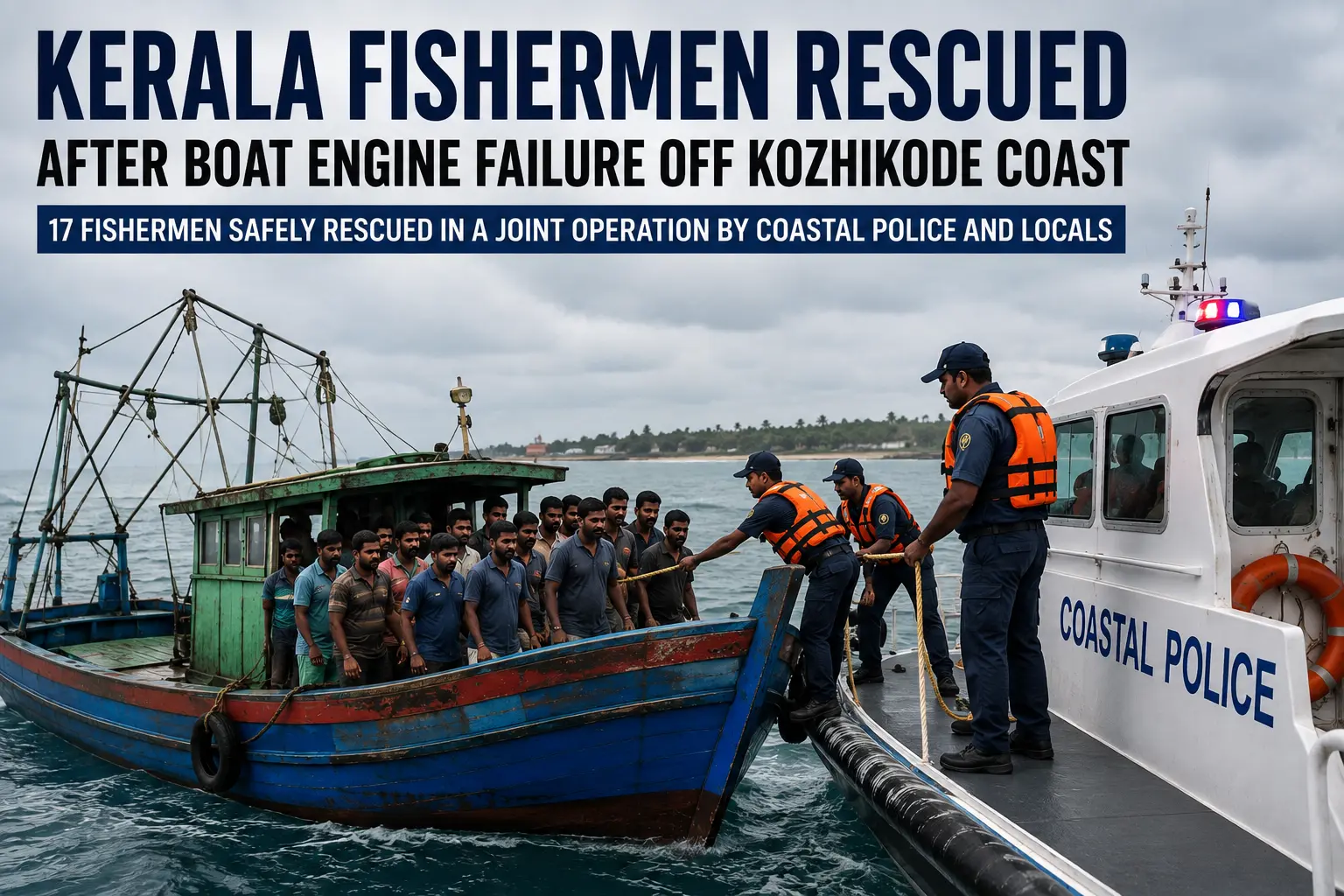
Seventeen fishermen were successfully rescued off the Kozhikode coast in Kerala after their fishing vessel suffered an engine failure while operating in the Arabian Sea. The rescue operation, carried out jointly by the Coastal Police and local residents, ensured that all crew members were brought back to safety without any reported injuries.
The incident highlighted both the unpredictable nature of sea voyages and the importance of rapid emergency response systems along India’s coastline. Thanks to timely coordination between authorities and local fishing communities, the stranded fishermen were rescued before weather and sea conditions could worsen.
The successful operation has once again demonstrated the critical role played by coastal rescue agencies in protecting fishermen who regularly venture into the sea to earn their livelihood.
According to officials, the fishing boat experienced a mechanical problem while operating in the Arabian Sea off the Kozhikode coast. The vessel’s engine reportedly stopped functioning, leaving the boat unable to return to shore under its own power.
With limited options available in open waters, the crew immediately informed local authorities about the emergency. Rescue teams quickly assessed the situation and launched an operation to reach the stranded fishermen before changing weather conditions created additional risks.
Mechanical failures remain one of the most common emergencies faced by fishing vessels, particularly those operating long distances from the coastline.
After receiving the distress alert, the Kerala Coastal Police coordinated with local residents and experienced fishermen to begin rescue efforts.
Rescue boats were dispatched toward the stranded vessel, where officials located all 17 fishermen safe on board despite the difficult circumstances. The rescue teams successfully secured the vessel and safely transported everyone back toward the shore.
Authorities confirmed that none of the fishermen required hospitalization, and the operation concluded without any casualties.
The coordinated response prevented the situation from escalating into a more serious maritime emergency.
One of the key reasons behind the successful rescue was the participation of local fishermen and coastal residents who are familiar with the sea conditions around Kozhikode.
Community involvement often proves crucial during maritime emergencies because local fishermen possess valuable knowledge about tides, currents, navigation routes, and weather conditions.
Their cooperation with government agencies helped rescue teams locate the stranded vessel quickly and complete the operation efficiently.
Officials appreciated the support extended by the fishing community, emphasizing that such partnerships significantly strengthen coastal emergency response capabilities.
Following the rescue, officials once again reminded fishermen about the importance of conducting proper safety inspections before beginning fishing expeditions.
Routine maintenance of engines, navigation equipment, communication devices, and emergency safety gear can reduce the chances of mechanical failures at sea.
Authorities also encourage fishermen to:
These precautions help improve safety during fishing operations, particularly during unpredictable weather conditions.
Fishing remains one of Kerala’s most important traditional occupations, providing employment and income to thousands of families living along the state’s coastline.
Every day, hundreds of fishing vessels leave ports across Kerala to catch fish in the Arabian Sea. While modern equipment has improved safety considerably, fishermen continue to face risks from rough seas, mechanical failures, changing weather, and navigation challenges.
Government agencies continue working with fishing communities to improve safety standards through awareness campaigns, better communication systems, modern rescue equipment, and training programmes.
India has significantly strengthened its coastal emergency response mechanisms over the past decade.
State Coastal Police units, the Indian Coast Guard, local fisheries departments, and district administrations regularly coordinate during maritime emergencies. Advanced communication systems, GPS tracking, weather forecasting, and faster rescue boats have greatly improved response times.
Quick coordination between multiple agencies often determines whether stranded fishermen can be rescued safely before conditions deteriorate.
Experts say continued investment in maritime rescue infrastructure will help strengthen coastal safety across India.
Although the rescue operation concluded successfully, maritime experts note that sea conditions can change rapidly even when weather appears stable near the coastline.
Strong winds, rough waves, heavy rainfall, and reduced visibility may develop within a short period, making rescue operations more difficult.
For this reason, authorities continuously monitor weather forecasts issued by the India Meteorological Department and frequently advise fishermen against venturing into the sea during adverse conditions.
Following official advisories remains one of the most effective ways to reduce maritime accidents.
Modern technology has become increasingly important in protecting fishermen operating far from shore.
GPS navigation devices, satellite communication systems, emergency distress transmitters, digital weather alerts, and mobile applications now help fishing crews receive timely information while at sea.
Several state governments have also introduced digital monitoring systems that allow authorities to respond more quickly when fishing vessels report emergencies.
Expanding access to such technologies can significantly reduce risks associated with mechanical failures and unexpected weather events.
Along with improving maritime safety, both the Central Government and the Kerala Government continue implementing welfare measures for fishing communities.
These include financial assistance programmes, accident insurance, modern fishing equipment, infrastructure improvements at fishing harbours, and training initiatives focused on safety and disaster preparedness.
Officials have repeatedly emphasized that protecting fishermen remains a priority, given their contribution to food security and the coastal economy.
Continued investment in rescue infrastructure and safety awareness is expected to further strengthen emergency preparedness along Kerala’s coastline.
Coordinated emergency response teams successfully rescued 17 Kerala fishermen after their boat suffered an engine failure off the Kozhikode coast, highlighting the effectiveness of their rescue efforts. Prompt action by the Coastal Police and local residents ensured that all crew members returned safely without injuries. The incident also serves as an important reminder of the challenges faced by fishing communities and the need for regular vessel maintenance, weather monitoring, and strong coastal rescue systems. As authorities continue strengthening maritime safety measures, such collaborative rescue efforts remain essential for protecting lives at sea.
Source: ANI

Your trusted source for news, updates, and insights from India and around the world.
Copyright © 2020–2026 NEWSHOTS. All Rights Reserved.