
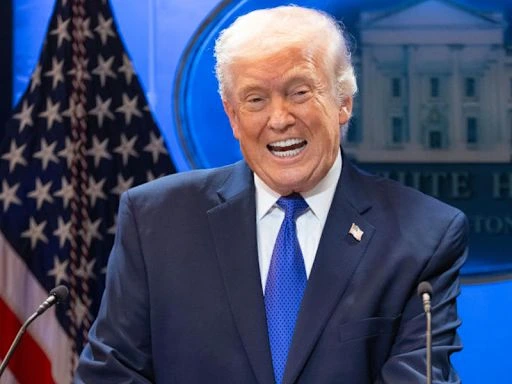
21-feb-2026, 12:52 PM, U.S. President Donald Trump said India would continue to pay tariffs after the U.S. Supreme Court struck down the legal basis for many of his administration’s sweeping tariffs.
Trump’s comments came after the Supreme Court ruled on February 20, 2026, that the International Emergency Economic Powers Act (IEEPA) does not give the President authority to impose tariffs. The decision was reached by a 6-3 majority vote. President could never impose tariffs.
The ruling immediately created uncertainty around the tariff arrangements that the United States had negotiated with several trading partners, including India.
The situation was particularly significant for India because the two countries had announced an interim trade framework earlier in February that included an 18% U.S. reciprocal tariff on originating Indian goods.
What Did Trump Say About India?
Following the Supreme Court decision, Trump said the tariff arrangement with India would continue.
Trump was quoted as saying that India would pay tariffs while the United States would not, arguing that the trade arrangement with India was fair.
His statement reflected his broader position that foreign countries should bear a greater share of the cost associated with tariffs imposed on their exports to the United States.
However, the legal situation following the Supreme Court ruling was more complicated than the political statement suggested.
The Court had ruled that IEEPA did not provide the authority needed for the sweeping tariffs imposed under that law. This meant the administration needed to use other legal mechanisms to maintain tariff measures.
What Did the Supreme Court Rule?
The Supreme Court case involved the question of whether IEEPA, a 1977 federal law, gave the President the power to impose tariffs.
The court ruled that it did not.
In a 6-3 decision, the justices rejected the administration’s interpretation of the law and struck down the tariff authority being challenged.
The ruling did not mean that the U.S. President could never impose tariffs.
Instead, it meant that IEEPA could not be used as the legal authority for these tariffs.
That distinction became important because the administration could consider other laws that provide different forms of tariff authority.
What Was the India-US Trade Arrangement?
Before the Supreme Court ruling, India and the United States had reached a framework for an interim agreement.
Under the February 6 framework, the United States agreed to apply an 18% reciprocal tariff rate on originating Indian goods.
The framework covered several categories, including textiles and apparel, leather and footwear, plastics and rubber, organic chemicals, home décor, artisanal products, and certain machinery.
The United States also said that, subject to the successful conclusion of the Interim Agreement, reciprocal tariffs could be removed on certain products, including generic pharmaceuticals, gems and diamonds, and aircraft parts.
India, meanwhile, agreed to reduce or eliminate tariffs on a range of U.S. industrial and agricultural products.
The framework was part of broader negotiations toward an India-US Bilateral Trade Agreement.
Why Did the Supreme Court Ruling Affect India?
The Supreme Court decision created uncertainty because the 18% reciprocal tariff framework had been connected to tariff authority under IEEPA.
India’s trade relationship with the United States therefore entered a new period of uncertainty just weeks after the two countries had announced the framework.
Indian exporters needed clarity about which tariff rates would actually apply to their goods and under which legal authority.
The situation also affected the broader trade negotiations because tariff policy had been an important part of the discussions between the two governments.
What Happened After the Ruling?
Following the Supreme Court decision, the Trump administration moved quickly to establish a replacement tariff mechanism.
Trump initially announced a 10% temporary global tariff under Section 122 of the Trade Act of 1974. The measure was designed as a replacement for the tariff authority affected by the Supreme Court decision.
Trump then announced that the global rate would be increased to 15%, the maximum rate allowed under Section 122. CBS News reported that Trump announced the increase on February 21.
This created additional uncertainty about the exact effective tariff burden on Indian goods.
What Tariff Rate Would India Face?
The answer was not immediately straightforward.
Before the Supreme Court ruling, the negotiated reciprocal rate for India under the February framework was 18%.
After the ruling, the legal basis for the IEEPA tariffs was removed.
The administration then moved toward a new tariff structure under Section 122.
India Today reported that the White House initially clarified that Indian goods would face the temporary global tariff rather than automatically retaining the previous 18% IEEPA-based rate.
The situation was therefore changing rapidly, and different public statements created confusion over whether the negotiated 18% rate would continue.
For a news report, it is important not to present the tariff rate as permanently settled when the legal and policy framework was still changing.
Impact on Indian Exporters
The uncertainty was important for Indian exporters because tariffs affect the final cost of goods entering the U.S. market.
Indian industries with significant exposure to the American market include textiles, pharmaceuticals, gems and jewelry, engineering products, machinery, and other manufactured goods.
A lower tariff can improve price competitiveness, while a higher tariff can increase costs for importers and potentially affect demand.
However, the effect varies by industry.
Some products may also be subject to separate U.S. tariff measures under other laws, meaning the overall tariff burden cannot always be determined by looking at one headline rate.
What Does This Mean for the India-US Trade Deal?
The Supreme Court ruling did not automatically cancel the broader India-US trade relationship.
The two countries had already agreed on a framework for an interim agreement and were working toward a broader bilateral trade agreement.
However, the ruling changed the legal environment in which the tariff framework had been developed.
That could affect future negotiations.
India could seek greater clarity or concessions as the United States determines how to implement its new tariff policy.
Reuters reported on February 22 that India had delayed plans to send a trade delegation to Washington following the Supreme Court decision and the subsequent U.S. tariff changes.
This showed how quickly the ruling was beginning to affect the broader negotiating process.
Why the Issue Matters for Both Countries
The United States and India have a major economic relationship covering goods, services, technology, investment, and supply chains.
Both countries have an interest in expanding bilateral trade while addressing disagreements over market access and tariffs.
For India, access to the U.S. market is particularly important for exporters.
For the United States, India represents a large consumer market and an increasingly important partner in technology, manufacturing, and supply-chain diversification.
A stable trade framework could therefore benefit businesses in both countries.
The challenge is reaching an agreement that addresses tariff differences while also protecting sensitive domestic industries.
What Should Happen Next?
The next stage will depend on how the United States implements its replacement tariff measures and how India responds.
Businesses and investors will be watching for:
- The final U.S. tariff structure
- The duration of the temporary Section 122 tariff
- Treatment of India under the new system
- Progress on the Interim Agreement
- Future India-US Bilateral Trade Agreement negotiations
- Sector-specific tariff exemptions
- Possible new U.S. tariff investigations
These developments could determine the actual impact on Indian exporters.
Conclusion
Donald Trump’s statement that India would continue to pay tariffs came at a time of major uncertainty in U.S. trade policy.
The U.S. Supreme Court ruled on February 20 that IEEPA does not authorise the President to impose tariffs, removing the legal basis for many of the administration’s sweeping tariff measures.
The ruling created questions around the India-US trade framework, which had included an 18% reciprocal tariff rate on Indian goods.
The Trump administration then moved toward a temporary tariff structure under Section 122, first announcing a 10% rate and subsequently raising it to 15%.
For India, the immediate priority is clarity over the tariff rate that will actually apply to its exports.
The broader India-US trade negotiations are likely to remain important as both countries work to resolve tariff differences and expand economic cooperation.
Sources: U.S. Supreme Court/SCOTUSblog, White House, Reuters, and India Today.


One thought on “Trump Says India Will Pay Tariffs After Supreme Court Ruling: What It Means”