
Your daily dose of news, covering the latest updates in politics, business, sports, entertainment, and more from India and around the world.
Your daily dose of news, covering the latest updates in politics, business, sports, entertainment, and more from India and around the world.
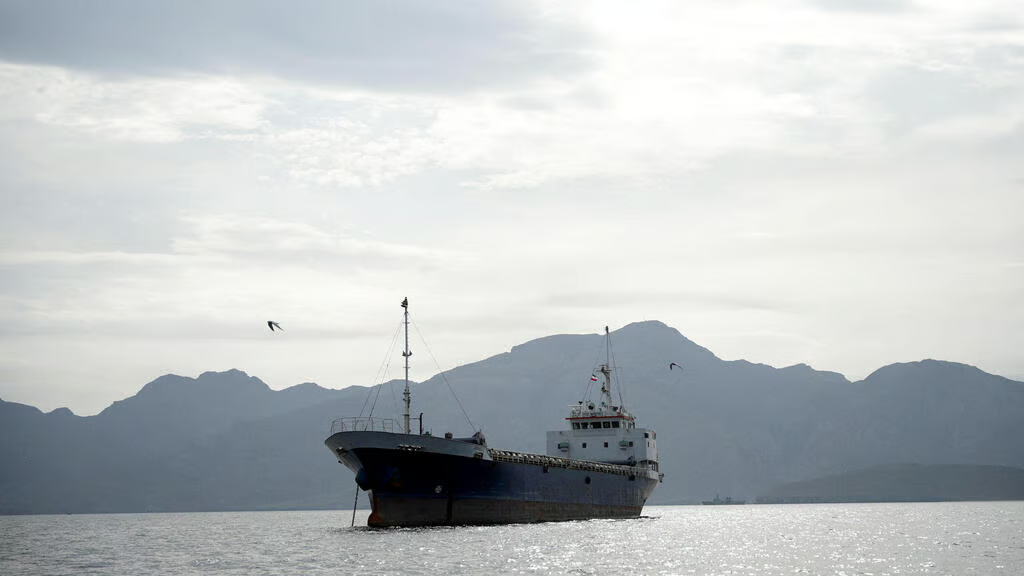
Growing tensions in the Middle East have once again placed the global spotlight on the Strait of Hormuz, one of the world’s most important maritime routes. Recent developments involving Iran and the United States have sparked concerns among governments, businesses, and energy markets, with officials warning that any disruption in the region could have far-reaching consequences for international trade and global economic stability.
The latest statements from Iranian authorities come amid increasing military activity and heightened diplomatic tensions in the Gulf region. As both sides continue to exchange strong messages, international observers are closely monitoring the situation due to its potential impact on energy supplies, shipping routes, and regional security.
The developments have renewed discussions about the importance of maintaining stability in one of the world’s most strategically significant waterways.
The Strait of Hormuz is widely regarded as one of the most important maritime passages on the planet.
Located between the Persian Gulf and the Gulf of Oman, the narrow waterway serves as a critical route for global energy transportation.
Every day, millions of barrels of oil and other energy products pass through the strait on their way to international markets.
Key Facts About The Strait Of Hormuz
Because of its importance, even minor disruptions in the area can attract worldwide attention and influence financial markets.
Recent developments have increased concerns about regional stability.
Remarks from Iranian and American officials have underscored increasing differences over regional security, trade routes, and military operations.
The situation has prompted governments and international organizations to call for restraint and continued diplomatic engagement.
Factors Contributing To The Tensions
Analysts note that tensions in the Gulf often have implications that extend beyond the countries directly involved.
One of the biggest concerns surrounding the situation involves commercial shipping.
Thousands of vessels use Gulf trade routes every year to transport energy resources and other goods to international markets.
Shipping companies closely monitor developments because uncertainty can affect transportation schedules, operational costs, and insurance requirements.
Potential Effects On Maritime Trade
Industry experts emphasize that maintaining uninterrupted maritime traffic remains important for international trade stability.
Developments related to the Strait of Hormuz often draw close attention from global energy markets due to the route’s strategic importance to international oil and gas shipments.
Because a significant share of international oil shipments passes through the region, any perceived threat to transportation routes can influence market sentiment.
Why Energy Traders Are Watching Closely
Energy analysts frequently point out that geopolitical developments in the region can influence prices even when actual supply disruptions do not occur.
As a result, market participants continue to monitor every major announcement and diplomatic development.
The strategic importance of the Strait of Hormuz extends far beyond energy markets, influencing global trade, regional security, and international economic stability.
A prolonged period of instability could affect various sectors of the global economy, particularly those dependent on stable transportation networks and predictable fuel costs.
Areas That Could Be Impacted
Countries that rely heavily on imported energy resources often pay close attention to developments in the Gulf due to their potential economic consequences.
Despite heightened rhetoric, diplomatic engagement remains an important part of efforts to reduce tensions.
Several countries and international organizations continue to encourage dialogue and peaceful solutions.
Diplomatic channels are often viewed as essential for preventing misunderstandings and reducing the risk of further escalation.
Goals Of Ongoing Diplomatic Efforts
Many observers believe diplomacy remains the most effective path toward reducing uncertainty and restoring confidence.
The Gulf region occupies a central position in global commerce and energy transportation.
As a result, stability in the area is considered important not only for neighboring countries but also for the broader international community.
Why Stability Matters
Maintaining secure shipping routes has long been a priority for governments, businesses, and international organizations.
Financial markets frequently react to geopolitical developments involving major trade routes.
Investors often assess potential risks and adjust expectations based on evolving conditions.
Market Areas Watching The Situation
While markets can react quickly to headlines, analysts caution that long-term trends depend on actual developments rather than speculation.
Attention is now focused on future diplomatic discussions, official statements, and developments in regional security.
Governments and businesses alike are seeking clarity regarding the direction of events.
Key Areas To Watch
Observers expect the coming weeks to be important in determining whether tensions ease or remain elevated.
The latest developments involving Iran and the United States have once again highlighted the strategic importance of the Strait of Hormuz and the broader Gulf region. As one of the world’s most significant trade and energy corridors, the waterway remains central to discussions about international security, economic stability, and global commerce.
While strong statements have increased concerns, diplomatic efforts continue alongside ongoing monitoring by governments and international organizations. The outcome of these developments will likely influence not only regional relations but also broader conversations about trade security and global economic stability.
For now, the focus remains on dialogue, stability, and ensuring that one of the world’s most critical maritime routes continues to support international trade and energy transportation without disruption.
Source: Associated Press (AP)

Your trusted source for news, updates, and insights from India and around the world.
Copyright © 2020–2026 NEWSHOTS. All Rights Reserved.