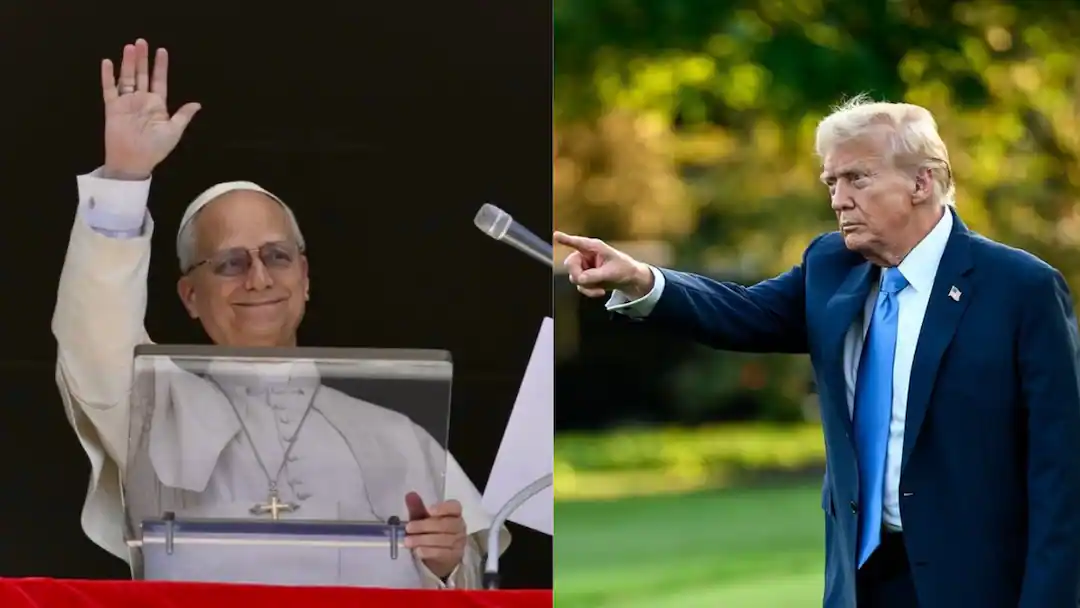
14-April-2026, 12:50 PM A fresh diplomatic row appears to be brewing after Pope Leo stated that he has “no fear” of Donald Trump, responding to the latter’s reported remark calling him “weak.” The exchange has drawn global attention, highlighting growing friction between religious leadership and political rhetoric.
Pope Leo’s Strong Response
Speaking to the media, Pope Leo made it clear that he remains unfazed by criticism from political figures. His statement, “I have no fear,” signals a firm stance amid escalating verbal exchanges.
The Vatican has not elaborated further on the context of Trump’s comment, but the Pope’s response suggests a refusal to engage in personal attacks while maintaining a position of moral authority.
Trump’s ‘Weak’ Remark
Former US President Donald Trump reportedly described the Pope as “weak,” though the exact context of the statement remains unclear. Trump is known for his direct and often controversial communication style, which frequently sparks strong reactions both domestically and internationally.
This latest remark appears to have crossed into sensitive territory, given the global influence of the Vatican and its leader.
Vatican-US Dynamics in Focus
The exchange has brought attention to the relationship between the Vatican and US political figures. While historically diplomatic, such public remarks can create tension and complicate dialogue on key global issues.
The Vatican often plays a significant role in addressing humanitarian concerns, peace efforts, and ethical debates—areas where political and religious perspectives sometimes diverge.
Global Reactions
Reactions to the incident have been mixed. Supporters of Pope Leo have praised his calm yet assertive response, while Trump’s supporters argue that political leaders have the right to critique global figures.
Observers note that such exchanges reflect the increasingly polarized nature of global discourse, where even religious leaders are not immune to political criticism.
Broader Implications
This development goes beyond a personal exchange. It highlights:
- The intersection of religion and politics
- The influence of global leaders on public discourse
- The role of diplomacy in managing disagreements
Such moments can shape public perception and influence international relations, especially when they involve high-profile figures.
What Happens Next?
It remains to be seen whether this exchange will escalate further or be resolved through quieter diplomatic channels. Historically, such tensions are often diffused through back-channel communication.
However, in the age of instant media, public statements can quickly gain traction and prolong controversies.
A Delicate Exchange Between Two Influential Figures
The reported exchange has attracted attention largely because both figures hold considerable influence in their respective spheres. Statements involving a Pope and a major political figure can quickly move beyond a personal disagreement and become part of a broader international conversation.
Pope Leo’s response has been interpreted as an attempt to maintain composure while firmly rejecting the suggestion that criticism or political pressure could intimidate him. His choice of words has therefore become a central part of discussions surrounding the incident.
At the same time, Trump’s reported description of the Pope as “weak” has raised questions about the tone of political commentary involving religious leadership. The lack of clear context surrounding the remark makes it difficult to determine the precise intention behind it.
Religion and Political Discourse
The incident also highlights the complicated relationship between religious institutions and political leadership. Religious leaders frequently comment on humanitarian issues, social concerns, conflict, peace, and moral questions, while political leaders are often required to respond to matters involving national and international policy.
These overlapping areas can sometimes produce disagreements, particularly when statements from one side are interpreted as criticism by the other. Public exchanges can attract even greater attention when they involve internationally recognised personalities.
The Pope’s position gives the Vatican a unique role in global discussions, while Trump’s political influence ensures that his public statements receive considerable media attention. This combination has contributed to the interest surrounding the reported exchange.
Why the Statement Has Drawn Attention
The phrase “I have no fear” has become particularly significant because it conveys confidence without necessarily indicating an intention to escalate the dispute. Such wording can be viewed as an attempt to draw a line between accepting criticism and allowing criticism to influence one’s position.
In an increasingly media-driven environment, even a short statement from a prominent leader can generate extensive discussion. News organisations, commentators, and social media users often analyse individual phrases and examine their wider political or diplomatic implications.
The incident demonstrates how quickly a brief exchange can become an international talking point when it involves high-profile personalities.
Potential Diplomatic Sensitivity
Although the reported comments appear primarily verbal, incidents involving prominent political and religious figures can create diplomatic sensitivity. The Vatican maintains relationships with governments and institutions around the world, while the United States remains a major actor in international affairs.
Any continued exchange of public remarks could therefore attract additional attention from political observers. At the same time, diplomatic channels can provide opportunities for disagreements to be managed privately rather than allowing public statements to dominate the relationship.
For now, the available information suggests that the focus remains on the statements themselves and the reactions they have generated.
Public Debate Continues
The episode has also sparked a wider discussion about how influential figures should communicate when disagreements arise. Supporters of stronger political language may argue that public figures should be able to express criticism openly, while others believe that disagreements involving religious leaders should be handled with greater restraint.
Regardless of differing interpretations, the exchange demonstrates the continuing influence of public statements in shaping international conversations. The reaction to Pope Leo’s response shows that audiences remain highly interested in moments where religion, politics, diplomacy, and personal rhetoric intersect.
The situation will ultimately depend on whether further statements emerge from either side. For now, Pope Leo’s firm response and Trump’s reported criticism remain at the centre of the discussion, with observers watching closely for any further development.
Conclusion
Pope Leo’s declaration that he has “no fear” of Donald Trump underscores a moment of tension between religious authority and political leadership. As global attention remains fixed on this exchange, it serves as a reminder of how words from influential figures can resonate far beyond their immediate context.
Source: Reuters