
Your daily dose of news, covering the latest updates in politics, business, sports, entertainment, and more from India and around the world.
Your daily dose of news, covering the latest updates in politics, business, sports, entertainment, and more from India and around the world.
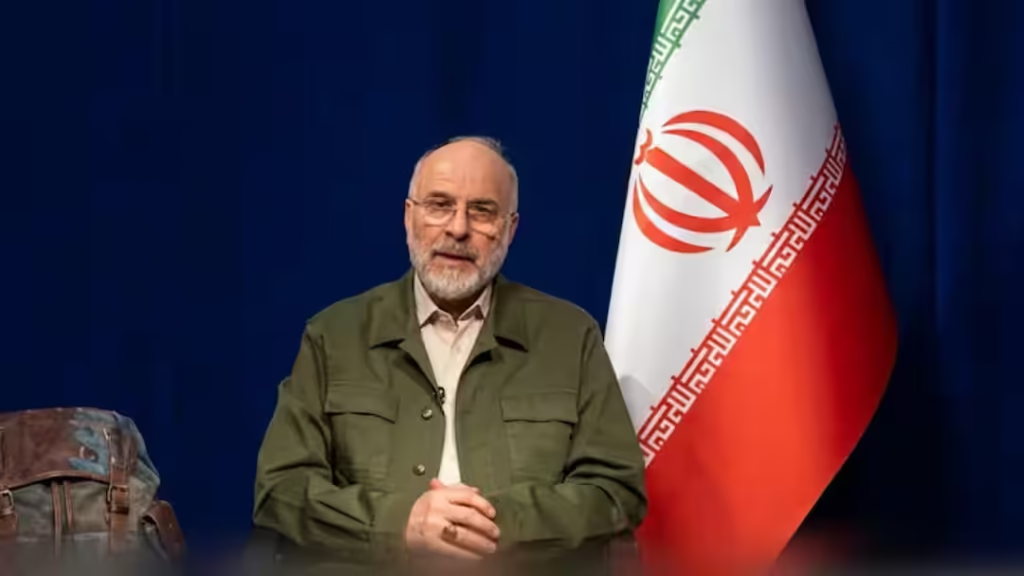
Tensions between Iran and the United States have once again moved into the spotlight after senior Iranian officials signaled a tougher position on future negotiations. Tehran has stated that it will not participate in talks conducted under pressure and warned that it has prepared what it described as “new battlefield cards” should regional tensions escalate further.
The comments come at a sensitive moment for Middle East diplomacy, with uncertainty surrounding ceasefire arrangements, security concerns in strategic waterways, and ongoing disagreements over sanctions, military activity, and regional influence.
The latest statements have drawn international attention because of their potential implications for regional stability, energy markets, and future diplomatic efforts between the two countries.
Iranian officials have made it clear that they oppose negotiations that they believe are conducted under threats or coercion.
According to public statements, Tehran maintains that diplomacy should be based on mutual respect and equal engagement rather than pressure tactics.
Officials argued that attempts to negotiate while maintaining economic sanctions or military pressure make constructive dialogue more difficult.
Key Points From Iran’s Position
The remarks suggest that Iran intends to maintain a firm negotiating position while continuing to monitor developments in the region.
Political analysts believe the statements are designed both for international audiences and domestic political considerations.
One of the most discussed aspects of the statement was the reference to “new battlefield cards.”
Iranian officials did not provide detailed explanations regarding what specific measures this phrase refers to.
However, analysts have offered several interpretations.
Possible Interpretations
Experts note that such language is often used as a deterrence message rather than an indication of immediate military action.
The objective may be to signal readiness while discouraging further escalation from opponents.
Relations between Iran and the United States have experienced periods of tension for decades.
Disagreements have centered around several issues, including:
While diplomatic channels have occasionally reopened, progress has often been interrupted by new disputes and geopolitical developments.
The latest exchange reflects the continuing difficulty both sides face in finding common ground on major policy issues.
The statements come as concerns grow regarding the future of existing ceasefire arrangements in parts of the region.
Recent reports have pointed to disagreements over compliance, enforcement, and military activity.
Issues Contributing To Tensions
Observers believe that uncertainty surrounding ceasefire arrangements has increased diplomatic pressure on all parties involved.
Any deterioration in the security situation could complicate ongoing efforts to reduce tensions.
One of the most strategically important areas connected to the dispute is the Strait of Hormuz.
The waterway is considered one of the world’s most important energy transit routes.
A significant portion of global oil shipments passes through this narrow corridor each day.
Why It Matters
Because of its strategic importance, developments involving the Strait of Hormuz are closely monitored by governments, investors, and energy markets worldwide.
Any disruption in the area can quickly affect global economic sentiment.
Why Iran Is Taking A Firmer Stance
Experts point to several factors that may explain Tehran’s increasingly assertive position.
Domestic Political Considerations
Strong public statements often serve to demonstrate resolve and reinforce national positions during periods of international pressure.
Strategic Negotiating Position
By adopting a firm stance, Iran may seek to strengthen its position ahead of any future diplomatic engagement.
Regional Security Concerns
Iran continues to view regional developments as closely linked to its national security interests.
Economic Pressures
Sanctions and economic restrictions remain significant issues influencing Iranian policy decisions.
Analysts suggest that the combination of these factors contributes to Tehran’s current approach.
The United States has continued to emphasize its own security and strategic priorities in the region.
American officials have repeatedly highlighted concerns regarding regional stability, security threats, and broader geopolitical interests.
Key Elements Of The US Position
The differing approaches adopted by Washington and Tehran remain one of the primary obstacles to achieving a diplomatic breakthrough.
Developments involving Iran and the United States frequently attract attention from financial and energy markets.
Investors often react to signs of rising geopolitical risk because of the potential impact on energy supplies and global trade.
Areas That Could Be Affected
Oil Markets
Concerns regarding supply routes can influence crude oil prices.
Financial Markets
Periods of uncertainty often increase market volatility.
International Trade
Shipping routes and logistics networks may face additional scrutiny.
Investor Sentiment
Geopolitical tensions frequently affect risk assessments across multiple sectors.
Market participants are therefore paying close attention to developments in the region.
What Experts Are Saying
Many geopolitical analysts describe the current situation as a complex diplomatic standoff.
According to experts:
Analysts also note that strong public statements do not always translate into immediate policy changes.
In many cases, such messages are intended to strengthen negotiating positions ahead of future discussions.
Several possible scenarios could emerge in the coming weeks.
Renewed Diplomatic Engagement
Both sides could eventually return to formal discussions if conditions become more favorable.
Continued Standoff
The current situation could persist without significant escalation or progress.
Increased Regional Tensions
Any security incident or misunderstanding could increase pressure on diplomatic efforts.
International Mediation Efforts
Other countries may attempt to encourage dialogue and reduce tensions.
For now, the situation remains fluid, with governments and international observers closely monitoring developments.
While Iran’s latest statements indicate a tougher position, diplomatic channels have not completely disappeared. The coming weeks may prove important in determining whether the focus shifts toward renewed negotiations or continued geopolitical uncertainty in one of the world’s most strategically significant regions.
Spurce: Source: X / Mohammad Bagher Ghalibaf

Your trusted source for news, updates, and insights from India and around the world.
Copyright © 2020–2026 NEWSHOTS. All Rights Reserved.