
Your daily dose of news, covering the latest updates in politics, business, sports, entertainment, and more from India and around the world.
Your daily dose of news, covering the latest updates in politics, business, sports, entertainment, and more from India and around the world.
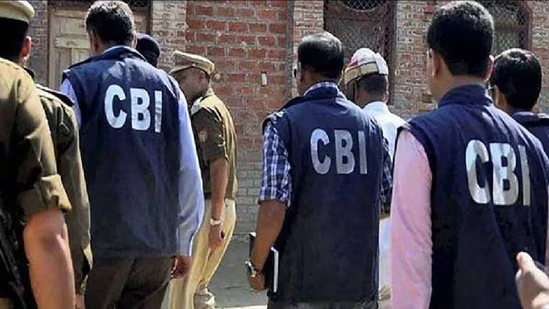
In a significant anti-corruption operation, the Central Bureau of Investigation CBI Arrests DGCA Deputy Director General with a senior executive of a private company in connection with an alleged ₹2.5 lakh bribery case. The arrests have drawn attention across India’s aviation sector and raised questions about transparency, accountability, and regulatory oversight.
According to officials, the case involves allegations that the DGCA officer demanded and accepted illegal gratification in exchange for providing regulatory assistance and facilitating approvals related to aviation operations. Acting on a complaint, the CBI launched an investigation, verified the allegations, and conducted a trap operation that resulted in the arrest of the accused.
The development is being viewed as an important step in the ongoing efforts to combat corruption within regulatory institutions and ensure greater accountability in public administration.
According to preliminary information released by investigating agencies, the case revolves around an alleged demand for ₹2.5 lakh in exchange for extending regulatory favours and facilitating approvals connected to aviation-related matters.
Officials stated that the complaint alleged misuse of an official position for personal benefit. Following verification of the complaint, the CBI initiated a carefully planned operation to gather evidence and monitor the alleged transaction.
Key Allegations Include:
Investigators believe the case may provide further insights into how regulatory processes can potentially be misused if adequate oversight mechanisms are not maintained.
The arrests were reportedly made after a trap operation conducted by the CBI.
Such operations are commonly used in corruption investigations and involve close monitoring of alleged transactions after complaints have been verified.
Officials stated that the operation was designed to ensure the collection of evidence that could be presented during legal proceedings.
Investigators are now examining additional documents, digital records, communication details, and financial transactions linked to the accused.
The Directorate General of Civil Aviation is India’s primary civil aviation regulator and plays a critical role in maintaining aviation safety and operational standards.
The organization oversees a wide range of responsibilities related to the country’s rapidly expanding aviation sector.
Key Functions Of DGCA
Given the importance of the DGCA’s responsibilities, any allegations of corruption involving senior officials attract significant public attention.
Experts note that confidence in regulatory institutions is essential for maintaining trust among airlines, aviation operators, passengers, and investors.
Despite the relatively small alleged bribe amount, experts argue that the case could have much broader implications than many high-profile corruption scandals.
The case highlights concerns about integrity within systems responsible for overseeing sectors where safety and compliance are critical.
Safety Implications
The aviation sector operates under some of the strictest regulatory frameworks globally. Any compromise in regulatory processes can potentially affect safety standards.
Fair Competition
If approvals are influenced by improper payments, it may create an uneven playing field for companies that follow established procedures.
Public Trust
Regulatory bodies depend heavily on public confidence. Allegations of corruption can weaken trust in institutions responsible for critical oversight.
Investor Confidence
Transparency and accountability are important factors for investors evaluating opportunities within the aviation sector.
Industry observers believe strong enforcement actions help reinforce confidence in regulatory systems.
Following the arrests, the CBI has reportedly expanded its investigation to determine whether additional individuals may have been involved.
Officials are examining:
Searches have reportedly been conducted at multiple locations connected to the accused.
Investigators are attempting to establish whether the incident represents an isolated case or whether broader patterns require examination.
The findings of the investigation may influence future regulatory reforms and compliance measures.
The accused have reportedly been booked under provisions of the Prevention of Corruption Act and other relevant legal provisions.
Possible Charges Include
Investigators are expected to produce the accused before a competent court and may seek further custody for questioning.
Legal experts point out that investigators typically scrutinize extensive documentary evidence and financial records before finalizing chargesheets in corruption cases.
The judicial process will ultimately determine individual responsibility based on the evidence presented.
India’s aviation industry has experienced significant growth over the past decade.
The sector continues to expand through increased passenger traffic, airport development, airline expansion, and infrastructure investments.
Incidents involving regulatory authorities can have broader implications for industry stakeholders.
Potential Effects
While such cases may initially raise concerns, industry experts believe that strong enforcement actions ultimately contribute to improving governance standards.
The case is also part of a broader effort by investigative agencies to address corruption across government departments and regulatory bodies.
In recent years, agencies have intensified actions aimed at improving transparency and accountability.
Areas Of Focus
Experts argue that consistent enforcement plays an important role in discouraging misconduct and promoting ethical practices.
The increasing use of digital systems and online approval mechanisms is also helping reduce opportunities for discretionary decision-making in many sectors.
The arrests have generated reactions from both industry participants and the general public.
Many observers have welcomed the swift action taken by investigative agencies, viewing it as a positive step toward strengthening institutional integrity.
Public Response
Industry Response
Several experts have emphasized that exposing and addressing such incidents is essential for long-term institutional reform.
organizations.
Experts suggest several measures that can help strengthen transparency:
Government departments are already implementing many of these measures as part of broader governance reforms.
Authorities will continue the investigation in the coming weeks as they review evidence and explore possible connections to other individuals or organizations.
Key developments to watch include:
Officials may also review existing aviation regulatory procedures to identify areas where they can strengthen safeguards.
As the case progresses, it is likely to remain under close scrutiny from both industry stakeholders and the public.
The outcome of the investigation could have implications not only for the individuals involved but also for future efforts aimed at improving transparency, accountability, and governance within India’s aviation sector.
Source: ANI

Your trusted source for news, updates, and insights from India and around the world.
Copyright © 2020–2026 NEWSHOTS. All Rights Reserved.