
Your daily dose of news, covering the latest updates in politics, business, sports, entertainment, and more from India and around the world.
Your daily dose of news, covering the latest updates in politics, business, sports, entertainment, and more from India and around the world.
By Chetanya Sarraf, July 31, 2026, 12:12 PM
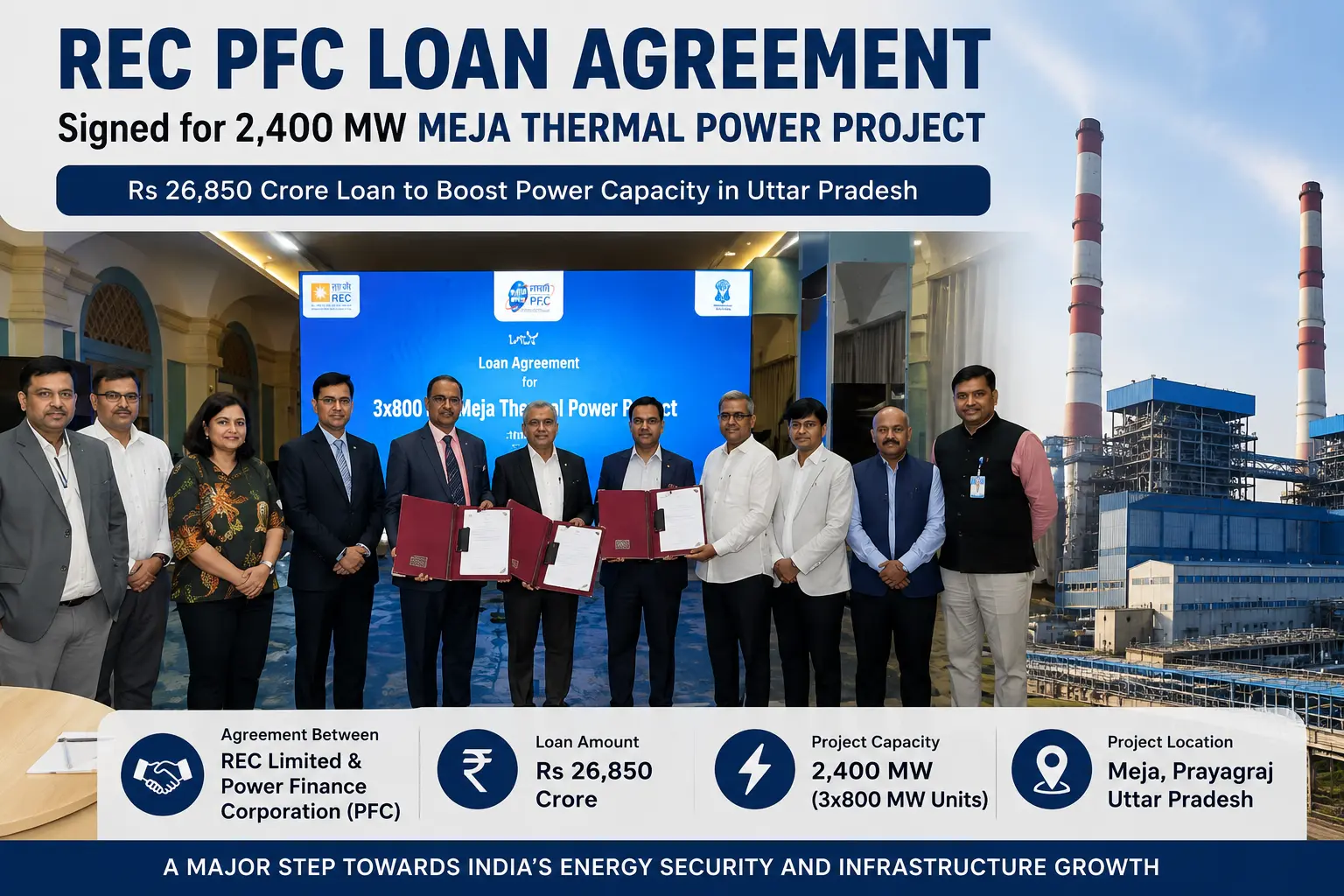
State-owned financial institutions REC Limited and Power Finance Corporation (PFC) have signed a Rs 26,850 crore common loan agreement to support the expansion of the 2,400 MW Meja Thermal Power Project in Uttar Pradesh. The agreement marks one of the largest financing deals in India’s power sector and is expected to strengthen the country’s electricity generation capacity while supporting rising energy demand.
The funding will enable Meja Urja Nigam Private Limited (MUNPL) to develop three ultra-supercritical thermal power units of 800 MW each under the Stage-III expansion of the Meja Thermal Power Project in Prayagraj district.
According to an official announcement, REC Limited and Power Finance Corporation have jointly provided financing to MUNPL through a common loan agreement valued at Rs 26,850 crore.
MUNPL operates as a joint venture between NTPC Limited and Uttar Pradesh Rajya Vidyut Utpadan Nigam Limited (UPRVUNL). The company will utilize the funds to construct three new 800 MW ultra-supercritical thermal power units, significantly increasing the project’s overall generating capacity.
The expansion is expected to play an important role in ensuring reliable electricity supply across northern India while supporting industrial growth and infrastructure development.
The Stage-III expansion of the Meja Thermal Power Project will add 2,400 MW of power generation capacity through advanced ultra-supercritical technology.
Ultra-supercritical thermal power plants operate with higher efficiency and lower emissions compared to conventional coal-fired power stations. These plants consume less fuel while generating more electricity, making them an important part of India’s strategy to improve energy efficiency.
The project is expected to strengthen the national power grid and help meet the country’s rapidly growing electricity requirements.
The estimated cost of the expansion project stands at approximately Rs 38,357 crore.
REC Limited will act as the lead financier, while PFC will serve as the co-financier, demonstrating strong collaboration between India’s leading public sector infrastructure financing institutions.
The financial closure provides a strong foundation for the project, enabling smooth implementation and timely completion.
India’s electricity demand has continued to rise due to rapid urbanization, industrial expansion, infrastructure development, and increasing household consumption.
Large-scale power generation projects such as the Meja Thermal Power Project remain essential for maintaining energy security while supporting economic growth.
Although India is investing significantly in renewable energy, thermal power continues to provide dependable base-load electricity required for uninterrupted power supply.
The expansion also supports government efforts to improve power availability across states and strengthen the country’s overall energy infrastructure.
The Meja Thermal Power Project expansion is expected to generate substantial economic benefits throughout its construction and operational phases.
Thousands of direct and indirect employment opportunities are likely to be created during project execution. Local businesses involved in transportation, construction materials, engineering services, logistics, and equipment supply may also benefit from increased economic activity.
Once operational, the project will contribute to stable electricity availability for industries, commercial establishments, and residential consumers, helping improve productivity and encourage further investment in the region.
Reliable electricity remains one of the key drivers of manufacturing growth, digital infrastructure, and overall economic development.
The three proposed 800 MW units will use ultra-supercritical technology, which has become the preferred choice for modern thermal power plants due to its improved operational efficiency.
Compared to older thermal plants, ultra-supercritical units operate at higher temperatures and pressures, resulting in improved fuel utilization and comparatively lower carbon emissions per unit of electricity generated.
These technological improvements align with India’s objective of modernizing its thermal power infrastructure while balancing energy security with environmental considerations.
REC Limited and Power Finance Corporation have consistently financed major infrastructure and power projects across India.
Both organizations play a critical role in funding generation, transmission, renewable energy, distribution, and infrastructure modernization projects.
Their continued investment in strategic power initiatives demonstrates their commitment to strengthening India’s long-term energy ecosystem and supporting national development goals.
The latest agreement further reinforces the confidence of public financial institutions in large-scale infrastructure projects that contribute to economic growth and improved energy access.
The Meja Thermal Power Project expansion will strengthen electricity supply across Uttar Pradesh and nearby states. As demand for reliable power continues to grow from households, industries, commercial establishments, and public infrastructure, projects of this scale play an important role in ensuring a stable energy supply.
The additional 2,400 MW generation capacity will help reduce pressure on the existing power grid, particularly during periods of peak electricity consumption. A stronger and more reliable electricity network also supports manufacturing, transportation, healthcare, education, and digital infrastructure, all of which depend on uninterrupted power.
Government agencies and power sector experts have emphasized that expanding generation capacity is essential for supporting India’s long-term economic growth. Investments in modern thermal power plants complement the country’s renewable energy initiatives by providing dependable base-load electricity when solar and wind generation fluctuate.
The REC–PFC loan agreement reflects the strong commitment of India’s leading public sector financial institutions to supporting key infrastructure development projects. Large-scale financing agreements such as this provide developers with the financial stability needed to execute complex projects on schedule while maintaining high engineering and safety standards.
Large-scale infrastructure investments also stimulate economic growth across multiple sectors beyond the power industry. The implementation phase will benefit construction companies, engineering firms, equipment manufacturers, logistics providers, and local suppliers. Once operational, the expanded plant will contribute to long-term energy security and support future industrial development across the region.
As India continues to modernize its power infrastructure, collaborations between institutions like REC Limited, Power Finance Corporation, and major power producers will remain crucial for meeting the country’s increasing electricity demand while strengthening overall economic development. The Meja Thermal Power Project expansion represents another important step toward building a more resilient and efficient energy ecosystem for the future.
The REC PFC Rs 26,850 Crore Loan Agreement represents a significant investment in India’s energy infrastructure. By financing the 2,400 MW Stage-III expansion of the Meja Thermal Power Project, REC and PFC are helping strengthen electricity generation capacity, promote efficient power production, and support the country’s growing energy requirements. The project aims to strengthen power reliability, support India’s infrastructure development, and create long-term economic benefits.
Source: ANI

Your trusted source for news, updates, and insights from India and around the world.
Copyright © 2020–2026 NEWSHOTS. All Rights Reserved.