
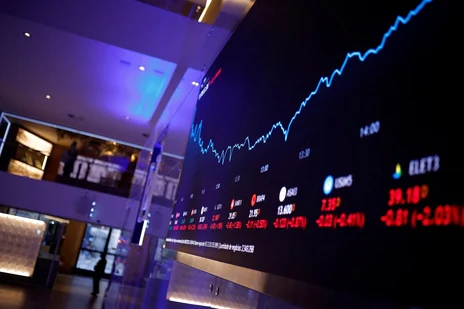
Sensex Jumps Nearly 489 Points, Nifty Crosses 24,000 Amid Market Recovery
India’s stock markets witnessed a strong rally as the BSE Sensex surged nearly 489 points, while the Nifty 50 crossed the crucial 24,000 mark. The market rebound reflects improving investor confidence and positive global cues that supported buying across key sectors.
The rally comes after a period of volatility in the markets, with investors responding positively to economic indicators, corporate earnings expectations, and stable global market sentiment.
Strong Market Recovery
The surge in Sensex and Nifty signals a notable recovery in Indian equity markets. Several large-cap stocks led the rally, especially in sectors such as banking, information technology, and financial services.
Analysts believe that positive economic indicators and strong domestic growth expectations have contributed to the bullish momentum. The market rebound also reflects confidence among investors regarding India’s economic outlook.
Banking and IT Stocks Lead Gains
Banking and technology stocks were among the biggest contributors to the market surge. Shares of major companies in these sectors saw significant buying activity as investors anticipated improved performance and steady growth.
Banking stocks often play a crucial role in driving market indices due to their heavy weightage. Similarly, IT companies tend to attract investor interest during global economic stability, as demand for digital services continues to grow.
Global Market Influence
Global market trends also played an important role in boosting investor sentiment. Positive cues from international markets helped support buying activity in Indian equities.
Improving economic data from major economies and stable commodity prices have eased concerns among investors. When global markets perform well, it often has a positive impact on emerging markets such as India.
Investor Confidence Returns
The rise in Sensex and Nifty indicates that investor confidence is gradually returning after recent fluctuations. Market participants appear optimistic about corporate earnings, economic growth, and policy stability.
Domestic investors, including retail investors and institutional funds, have continued to show strong participation in the markets. Their steady investments have helped support market resilience during periods of uncertainty.
Impact on Different Sectors
The rally was not limited to a single sector. Several industries benefited from the positive momentum in the markets.
Key sectors that recorded gains include:
Banking and financial services
Information technology
Automobile companies
Consumer goods firms
These sectors represent important pillars of India’s economy and often influence the movement of benchmark indices.
Experts’ Views on the Market Trend
Market experts suggest that the rally reflects improving economic sentiment both domestically and globally. Analysts believe that continued economic growth, government infrastructure spending, and strong consumption trends could further support equity markets.
However, they also advise investors to remain cautious, as global uncertainties such as geopolitical tensions, inflation concerns, and interest rate decisions may still influence market movements.
Long-Term Outlook for Indian Markets
India’s stock market has shown strong resilience over the years. With a rapidly growing economy, expanding digital infrastructure, and increasing participation from retail investors, the long-term outlook remains positive.
The country’s economic growth trajectory continues to attract global investors who see India as one of the most promising emerging markets.
Government initiatives focused on infrastructure development, manufacturing, and digital transformation are also expected to support long-term economic growth.
What the Market Rally Means for Investors
The sharp movement in the benchmark indices has renewed attention among investors following recent market volatility. A stronger Sensex and Nifty can improve overall market sentiment and encourage greater participation from both retail and institutional investors.
However, a single trading session does not necessarily indicate a permanent change in the market trend. Investors generally continue to monitor corporate earnings, economic data, global developments, and sector-specific performance before making investment decisions.
Role of Domestic Investors
Domestic participation remains an important factor supporting the resilience of Indian equity markets. Retail investors and domestic institutions have increasingly become significant participants in the stock market.
Steady domestic investment can provide support during periods when global investors reduce exposure to emerging markets. This domestic participation can also help markets recover more quickly following temporary periods of uncertainty.
Corporate Earnings in Focus
Investors are also keeping a close watch on corporate earnings and future business performance. Strong earnings growth can support share valuations, while weaker results may create pressure on individual stocks and sectors.
Companies operating in banking, technology, consumer goods, automobiles, and other major industries will remain important for understanding the broader direction of the market. Positive earnings expectations can encourage buying, although actual results may still influence investor sentiment.
Factors That Could Influence Markets Ahead
Despite the recent recovery, several factors could affect Indian equities in the coming sessions. Global interest rate decisions, inflation figures, currency movements, crude oil prices, and geopolitical developments remain important indicators for investors.
Domestic economic data and government policy announcements could also influence market sentiment. Investors are therefore expected to remain attentive to both international and Indian developments while assessing the sustainability of the current recovery.
Market Volatility Remains a Consideration
Even during a strong rally, equity markets can experience sudden fluctuations. Changes in global sentiment or unexpected economic developments can quickly affect investor expectations.
The latest gains provide a positive signal for market sentiment, but investors may continue to exercise caution and focus on long-term fundamentals. A balanced approach can help market participants navigate periods of both strong gains and temporary corrections.
Market participants will also assess whether the positive trend continues in the coming sessions. Sustained strength in large-cap stocks, improving corporate outlooks, and stable global cues could provide further support. At the same time, investors may remain cautious around major economic announcements and unexpected developments that could influence trading sentiment and trigger rapid movements in the market.
Conclusion
The surge in Sensex and Nifty reflects renewed optimism in India’s financial markets. As investor confidence improves and economic indicators remain positive, the market recovery signals a strong phase for Indian equities.
While short-term fluctuations are inevitable, the overall outlook for India’s stock market remains promising. For investors and market watchers, the latest rally serves as a reminder of the resilience and growth potential of the Indian economy.
SOURCE: ABP LIVE